In short
Eight tools made the list, each with its own sweet spot:
- Optiply is the best overall choice for online retailers and wholesalers, because it handles the order as well as the forecast.
- Prediko fits Shopify-first brands, Flieber multichannel sellers and StockTrim smaller budgets.
- Intuendi suits promotion-heavy retail, Cin7 Core an all-in-one inventory system, Inventory Planner open-to-buy planning and RELEX large retail chains.
How did we pick these tools?
For this overview, we selected eight AI demand forecasting tools based on their forecasting capabilities, user experiences and their reputation in the market. Together, they cover the most relevant choices for online retailers, wholesalers and retail chains, from Shopify-first brands to enterprise planning teams.
How do the top AI demand forecasting tools compare?
The table gives a side-by-side view of how each tool forecasts, what happens with the forecast and which systems it connects to.
| Tool | Best for | Forecasting approach | From forecast to purchase order | Key connections | Pricing model |
|---|---|---|---|---|---|
| Optiply | Online retailers and wholesalers that purchase daily | 40+ forecasting models and 10 years of supply chain data | Generates purchase orders and sends them to suppliers | 50+ integrations | Quote on request |
| Prediko | Shopify-first D2C brands | AI demand and supply planning | Replenishment alerts that create purchase orders | Shopify, Amazon, TikTok Shop, Walmart | Monthly subscription, tiered by annual GMV |
| Flieber | Brands selling on many marketplaces | Custom models built with Nixtla | Draft purchase orders, approved by you | Shopify, Amazon, eBay, Walmart (Magento, WooCommerce, bol.com assisted) | Monthly subscription, tiered plans |
| StockTrim | Small and mid-sized retailers and wholesalers | Machine learning with automatic model selection | Generates purchase orders you can send to suppliers | Shopify, WooCommerce, Lightspeed, Xero, QuickBooks | Monthly subscription, tiered by revenue |
| Intuendi | Retailers with frequent promotions and events | Machine learning with external drivers and event detection | Orders ready to review, grouped by supplier | Shopify, Magento, PrestaShop, Amazon, Odoo | Quote on request |
| Cin7 Core + ForesightAI | Businesses that want inventory management and forecasting in one system | AI forecasts up to 24 months ahead | Creates purchase orders inside Cin7 | Shopify, WooCommerce, Amazon, Xero | Cin7 subscription plus a paid ForesightAI add-on |
| Inventory Planner by Sage | Retailers that plan new-product buying against a budget | SKU-level forecasting with Sage AI recommendations | Purchase orders you email or push to your inventory system | Shopify, WooCommerce, Adobe Commerce, Lightspeed, Amazon | Quote on request |
| RELEX Solutions | Large retail chains | Machine learning that factors in promotions, weather and events | Automated replenishment through your back-end system | Project-based integration | Quote on request |
The 8 best AI demand forecasting software tools
Every tool below has its own strengths and limitations. For each one, you'll find how it works, its key features, what to keep in mind and what users say about it.
1. Optiply: best for online retailers and wholesalers that purchase daily
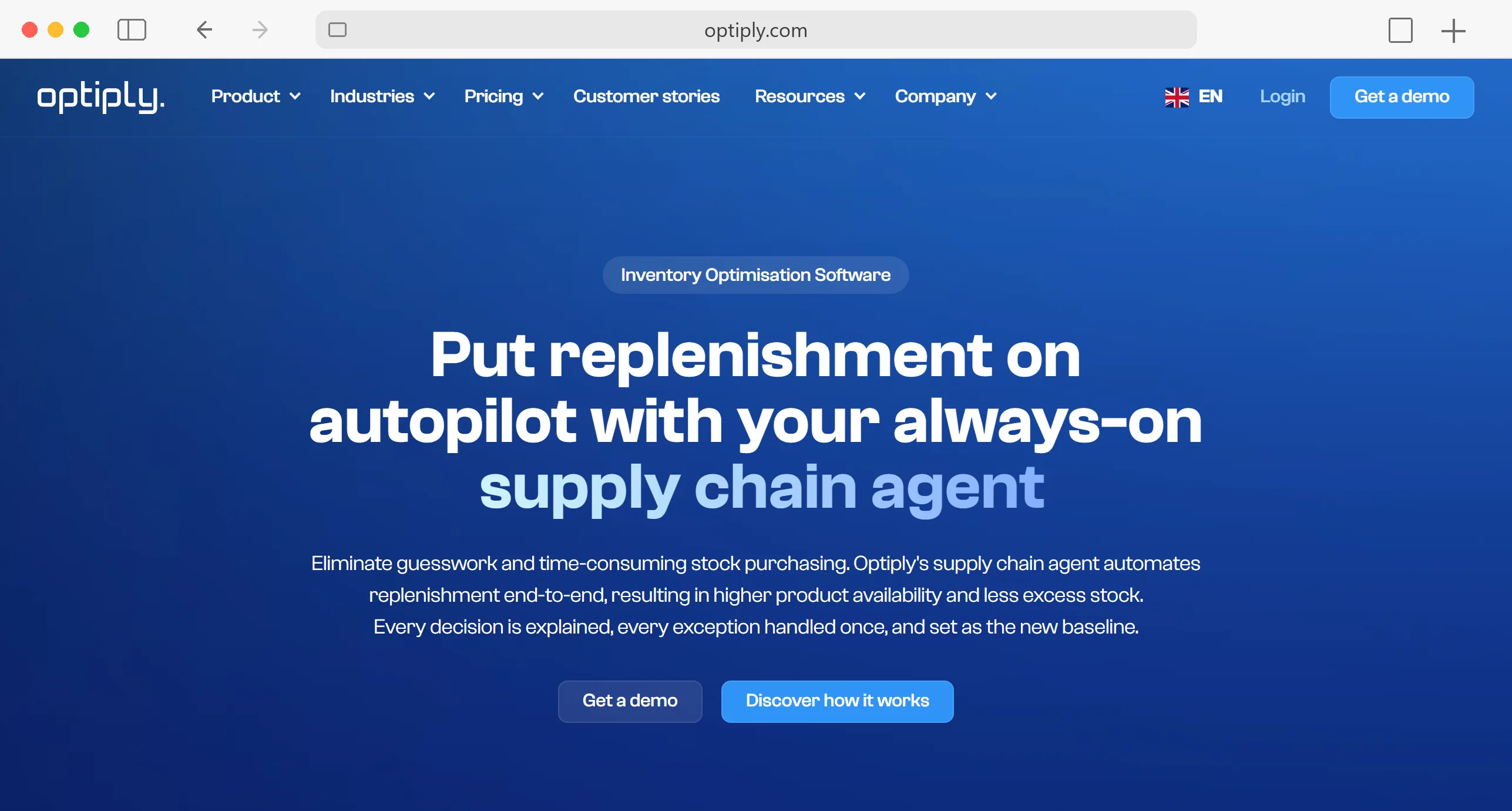
Optiply, that's us, is the AI-powered supply chain agent for e-commerce, retail and wholesale businesses. It forecasts demand for every product with 40+ forecasting models and 10 years of supply chain data, then turns that forecast into purchase orders and sends them to your suppliers.
Optiply explains every purchasing recommendation, so your buyers can see why it orders what it orders. More than 500 businesses use it today, and most are live within a few weeks.
Website: optiply.com
Best for: e-commerce businesses and wholesalers with 1,000+ SKUs and several suppliers, who want forecasting and purchasing in one automated flow.
Key features:
- A forecast for every product: each SKU gets the model that fits its sales pattern, from steady sellers to seasonal peaks and slow movers.
- Purchase orders that go out on their own: generated per supplier and sent, with MOQs, lead times and order moments already taken into account.
- Reasoning you can check: every order shows why it was proposed, so your buyers stay in control.
- Corrections that stick: an exception you handle once, like a supplier who's suddenly slower, becomes the new baseline.
- Works with your stack: 50+ integrations with webshops, marketplaces, ERP and warehouse systems.
Keep in mind: Optiply focuses on forecasting and purchasing, so it works alongside your inventory management or warehouse system. It pays off most when you have a sizeable assortment, roughly 1,000 products or more, and buy from several suppliers.
What users say about Optiply: Ledstores shows what these features look like in practice. The European LED lighting webshop used to steer its stock with manual min/max rules, and often ended up with too much of the wrong products and too little cash for the right ones. Once every product had its own forecast and orders followed the data instead of fixed minimums, Ledstores cut lost sales by 24% and lowered its inventory by 17%. Placing a purchase order went from over an hour to 15 minutes.
"The purchasing process has completely changed. Much more is known about seasonal demand and what needs to be purchased at certain times… we no longer manage our stock based on a manual min/max strategy but a data driven strategy with built in automation." - Nicolas Lubbers, Operational Purchaser, Ledstores
Curious how Optiply would handle your assortment? Book a demo and we'll show you on your own products and suppliers.
2. Prediko: best for Shopify-first brands
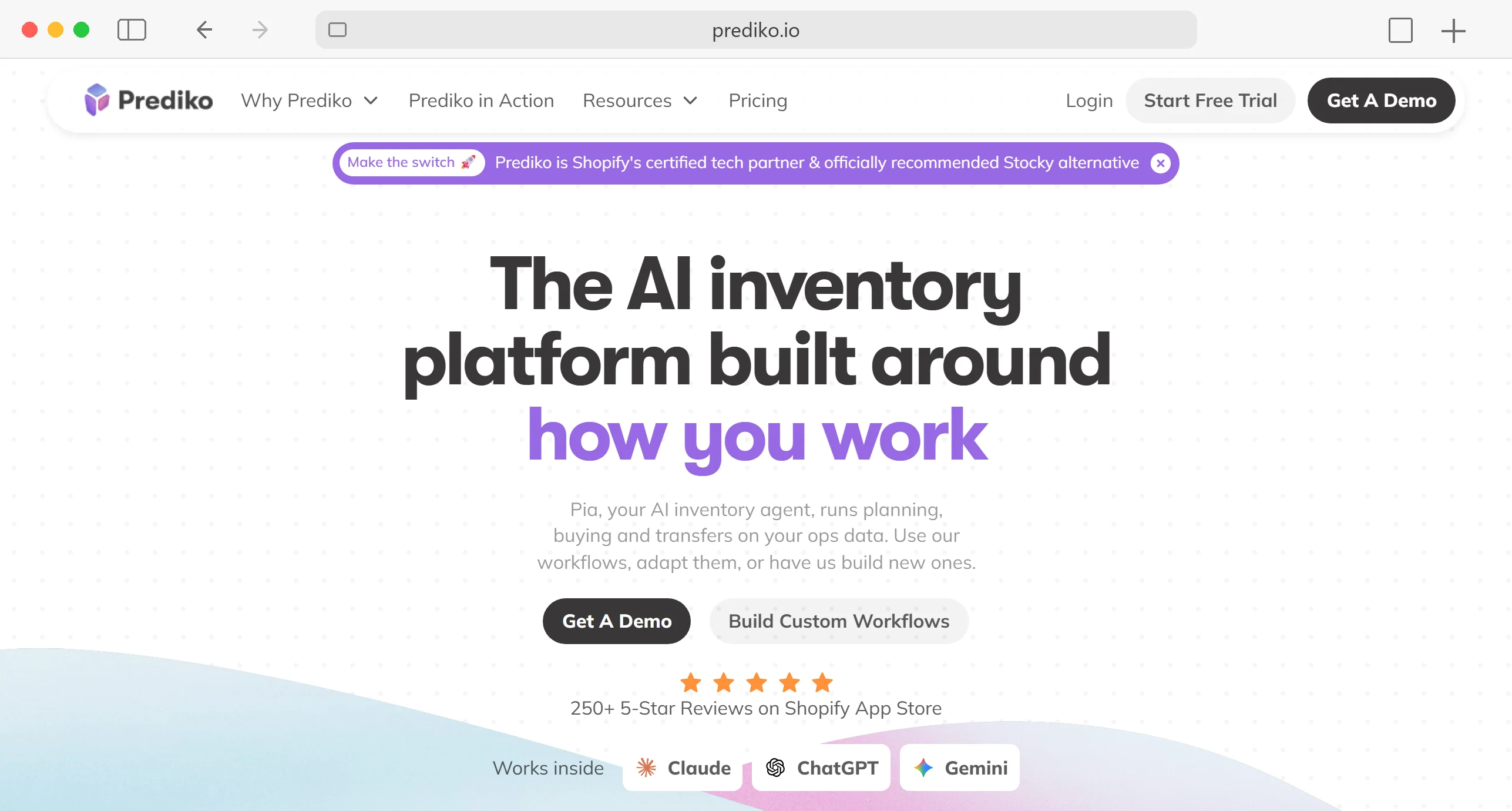
Prediko is an AI inventory planning app built for Shopify and D2C brands. It starts from your revenue target and works backwards, forecasting what each product needs to sell and when you need to reorder to get there.
The app sits inside Shopify, which makes it quick to set up for brands that run their business there.
Website: prediko.io
Best for: Shopify and Shopify Plus brands that want AI forecasting and purchase planning without leaving Shopify.
Key features:
- AI demand planning against a revenue target.
- 12-month purchase order calendar for supply planning.
- Replenishment alerts that create purchase orders.
- Pia, an AI inventory agent you can ask questions.
- Bill-of-materials forecasting as an add-on for brands that produce their own goods.
Keep in mind: Prediko is at its best when Shopify is the heart of your business. Personal onboarding and API access come with the higher plans, so smaller brands mostly set it up on their own.
What users say about Prediko: recent reviews on the Shopify App Store praise the hands-on onboarding and support, and describe Prediko as easy to start with and a clear step up from spreadsheets for forecasting and purchasing. A couple of reviewers would like better handling of bundles and raw materials.
3. Flieber: best for brands selling on many marketplaces
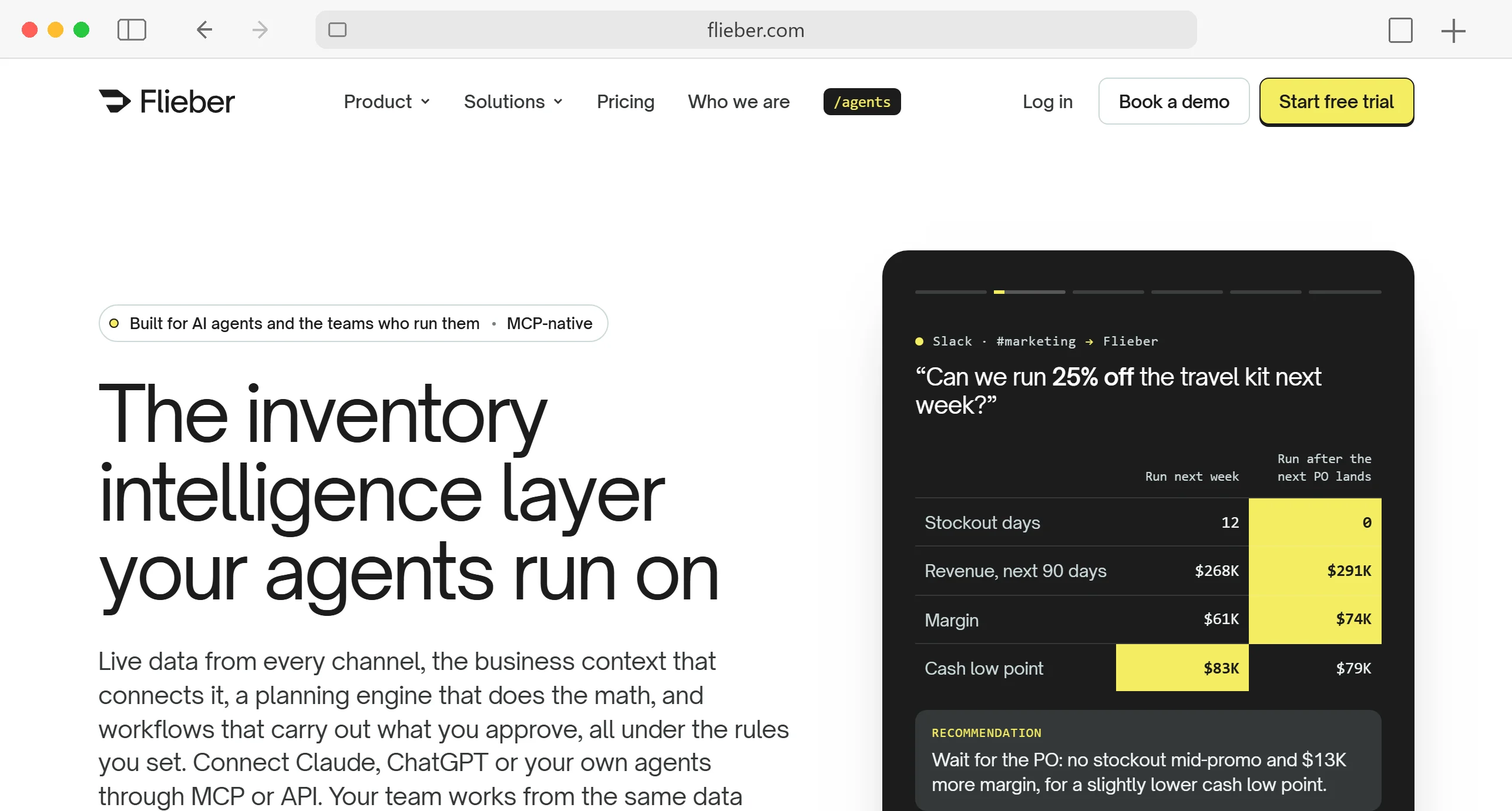
Flieber is a forecasting and planning platform for brands that sell across several channels at once. It forecasts per SKU and per channel, and corrects those forecasts for past stockouts and promotions, so a sold-out month doesn't drag your next order down.
Its forecasting models are built with Nixtla, a specialist in time-series forecasting. Flieber also offers a managed service, where its own planners run the planning for you.
Website: flieber.com
Best for: multichannel brands selling on Amazon, Shopify, Walmart and other marketplaces, with stock spread across several locations.
Key features:
- Channel-level forecasts corrected for stockouts and promotions.
- Stockout, overstock and lost-sales flags per product and location.
- Draft purchase and transfer orders, with scenario analysis before you commit.
- Native marketplace connections to Amazon, Shopify, Walmart, eBay, Etsy and TikTok Shop.
Keep in mind: by default, Flieber's recommendations wait for your approval and purchase orders start as drafts. That gives you full control, though your team still finalises every order.
What users say about Flieber: the reviews on the Shopify App Store are still few but positive, describing a simple tool with a support team that helps build custom setups and more accurate purchase orders across marketplaces.
4. StockTrim: best budget option for small and mid-sized businesses
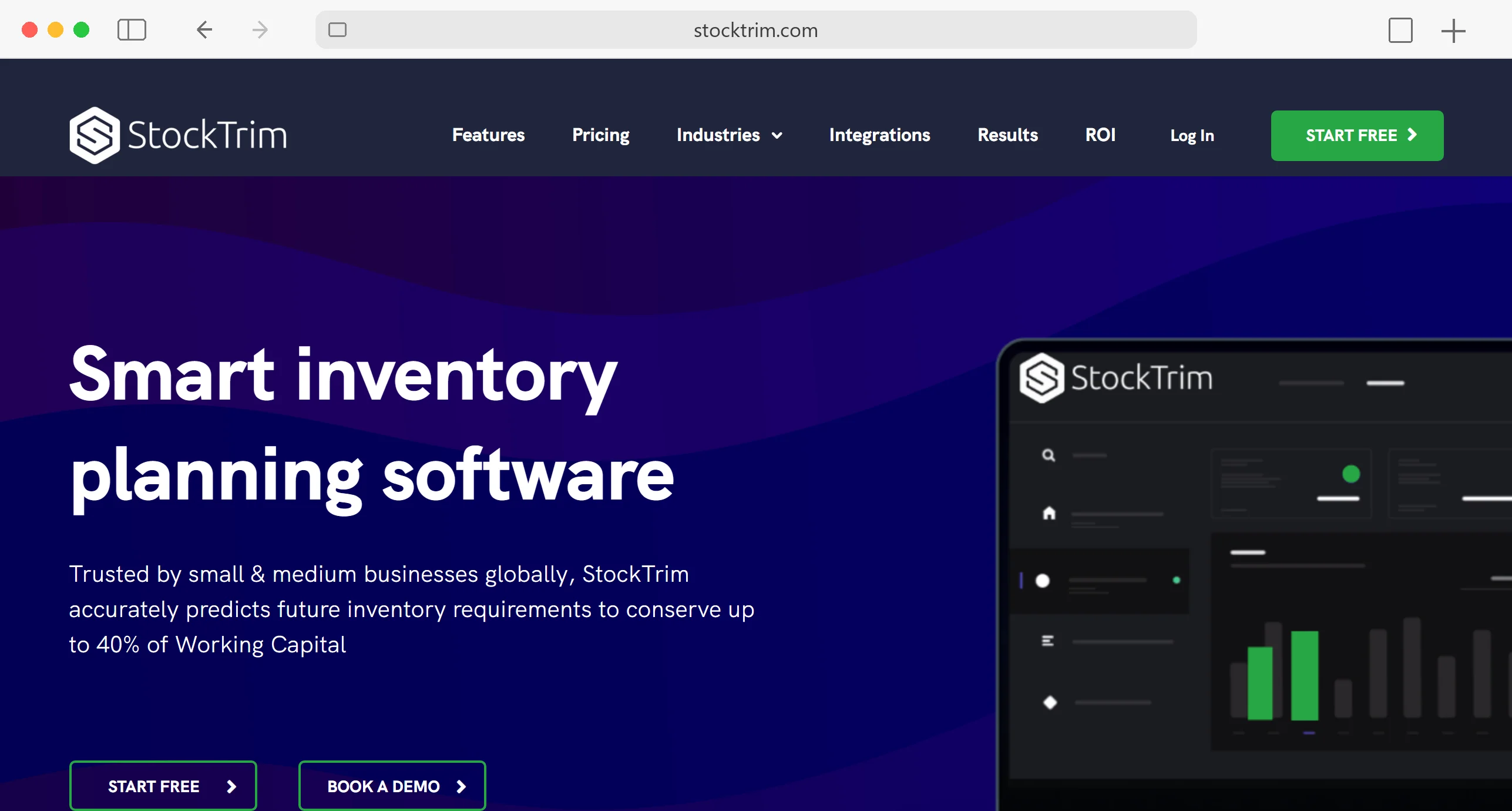
StockTrim is inventory planning software for small and medium-sized retailers, wholesalers and manufacturers. It uses machine learning to pick a forecasting model per product, and it can forecast new products that don't have any sales history yet.
From those forecasts, it builds an order plan and generates purchase orders, which you can send straight to your supplier or push back into your inventory system. Its plans are priced for smaller businesses, which makes it one of the more affordable options on this list.
Website: stocktrim.com
Best for: smaller retailers and wholesalers that want machine learning forecasting at an entry-level price.
Key features:
- Machine learning forecasting with automatic model selection.
- Forecasts for new products without sales history.
- Purchase orders sent to suppliers or back to your inventory system.
- Variable lead times and multi-location planning.
- Connections to Shopify, WooCommerce, Lightspeed, Xero, QuickBooks and Odoo.
Keep in mind: StockTrim is a smaller player with a modest number of public reviews, so it's worth asking for references from businesses like yours. Onboarding is a paid extra.
What users say about StockTrim: reviews on GetApp describe an easy-to-use dashboard, accurate automated forecasts and fast, helpful support. A few reviewers mention a learning curve at the start and the need to clean up product data before the forecasts run smoothly.
5. Intuendi: best for promotion-heavy retail
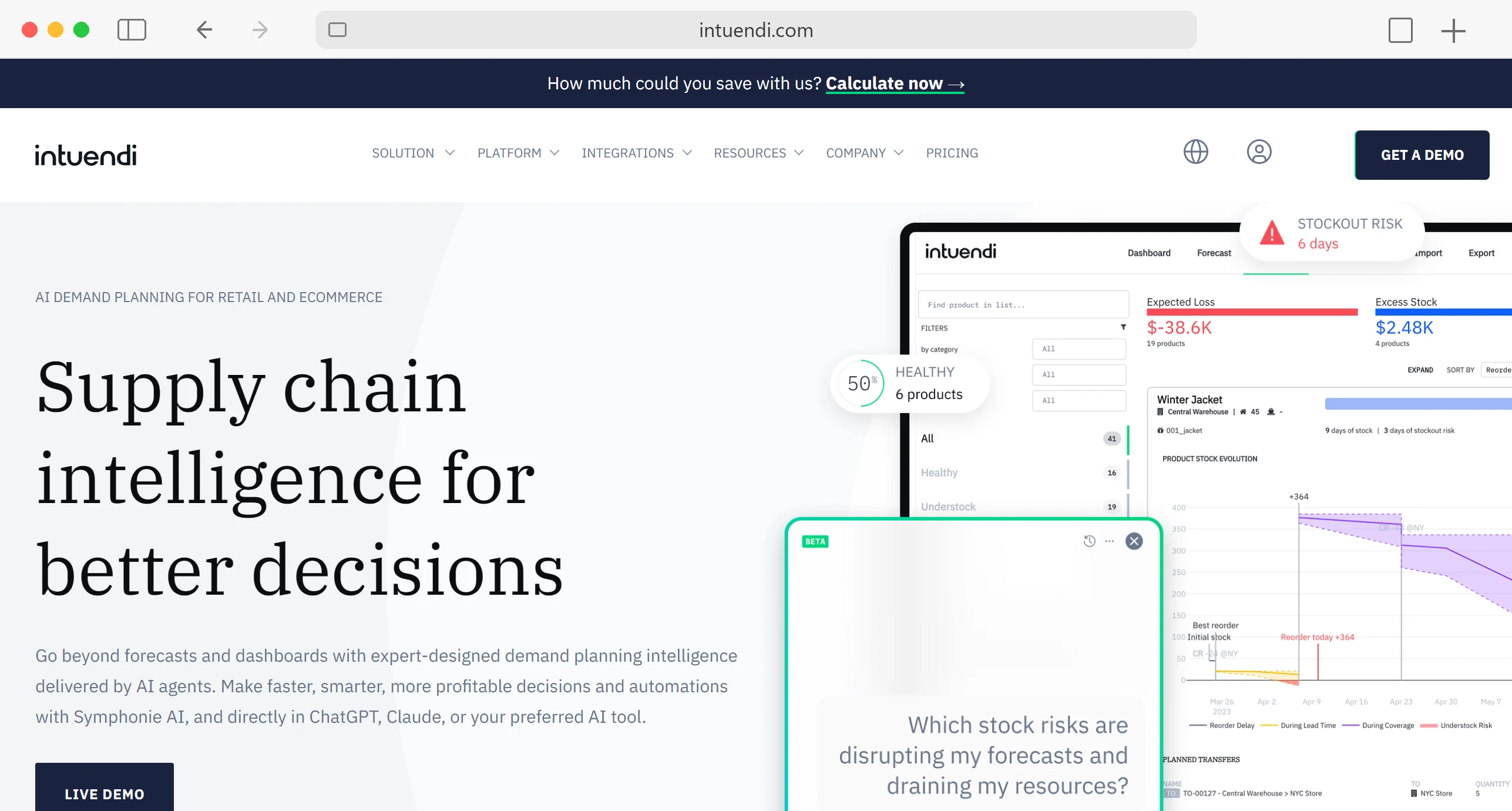
Intuendi is an AI demand planning platform for retail and e-commerce, developed in Italy. It forecasts per SKU and region, takes external drivers into account and detects unusual events in your sales, so a one-off spike doesn't distort the forecast.
It then prepares orders for you to review, ranked by urgency, grouped by supplier and explained line by line. That makes it a strong fit for teams with a dedicated planner who wants detailed control.
Website: intuendi.com
Best for: retailers with frequent promotions and events that plan demand per SKU and region.
Key features:
- SKU- and region-level forecasts with external drivers.
- Event detection that filters out one-off peaks and dips.
- Promotion and new-product planning.
- Orders ready for review, ranked by urgency and grouped by supplier.
- Connections to Shopify, Magento, PrestaShop, Amazon, NetSuite and Odoo.
Keep in mind: orders are prepared for review, ranked and explained, before anything goes to a supplier. Intuendi gives planners a lot of detail and control, which works best when someone on your team owns planning day to day.
What users say about Intuendi: reviews on GetApp describe Intuendi as easy to implement, with a responsive team and better control over stock. Some reviewers would like more insight into why a forecast or order suggestion comes out the way it does.
6. Cin7 Core + ForesightAI: best if you want an all-in-one inventory system
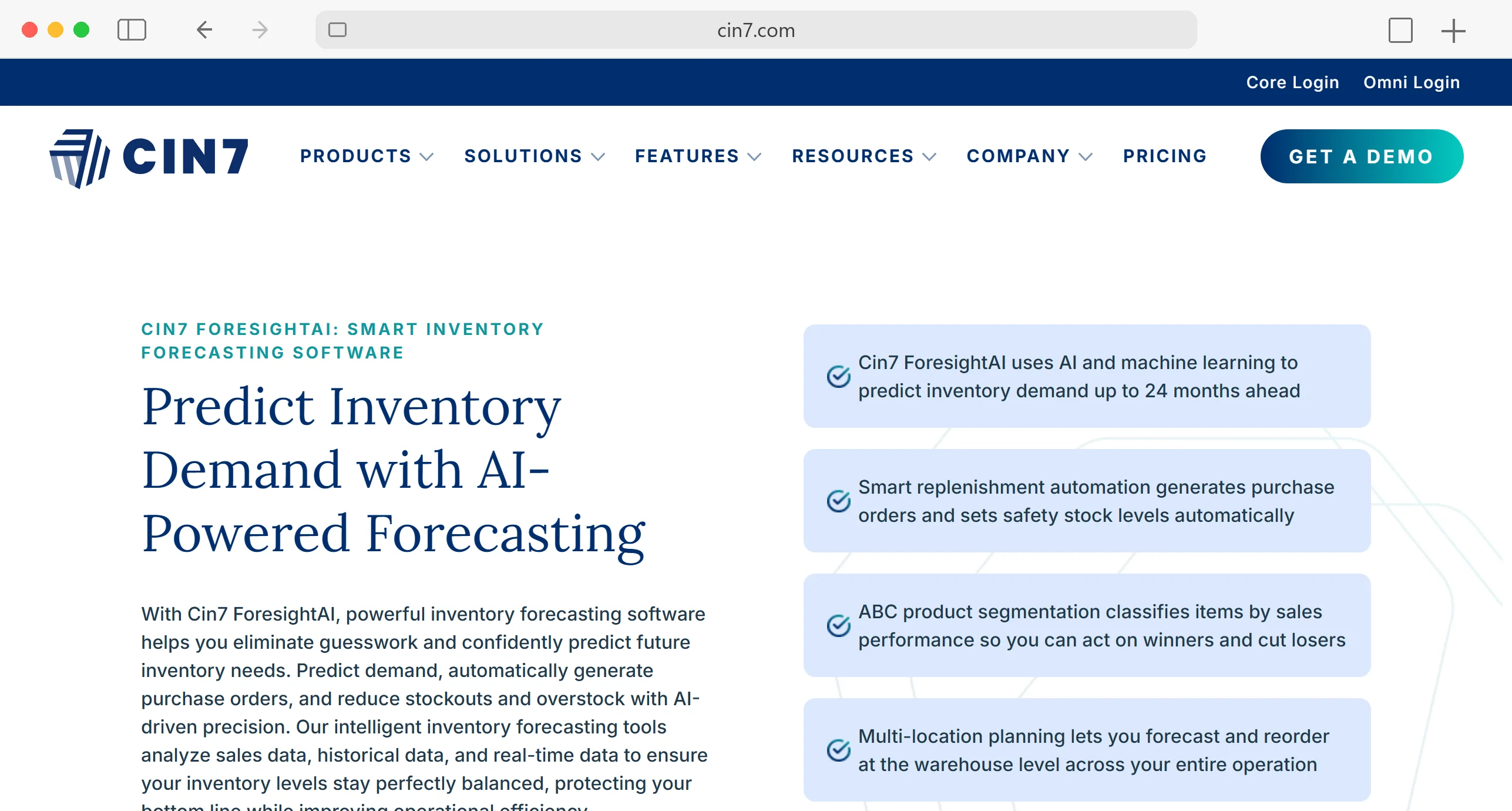
Cin7 Core is an inventory management system for product businesses, and ForesightAI is its AI forecasting add-on. Together they forecast demand up to 24 months ahead, set safety stock and create purchase orders based on what you're expected to need.
The appeal is having everything in one place: stock, orders, warehouses and forecasting. Cin7 also connects to a long list of sales channels and accounting tools.
Website: cin7.com
Best for: businesses that are shopping for a new inventory management system and want forecasting built into it.
Key features:
- Demand forecasts up to 24 months ahead.
- Automated replenishment and safety stock.
- ABC segmentation of your assortment.
- Warehouse-level reorders across multiple locations.
- Connections to Shopify, WooCommerce, Amazon, Xero and QuickBooks.
Keep in mind: the AI forecasting is an add-on to Cin7's inventory system, so it makes most sense if you're also ready to run your inventory in Cin7.
What users say about Cin7 Core: reviews on GetApp and the Xero App Store highlight the onboarding support and having inventory and orders across all channels in one system. Some reviewers mention a learning curve and would like quicker support.
7. Inventory Planner by Sage: best for open-to-buy planning
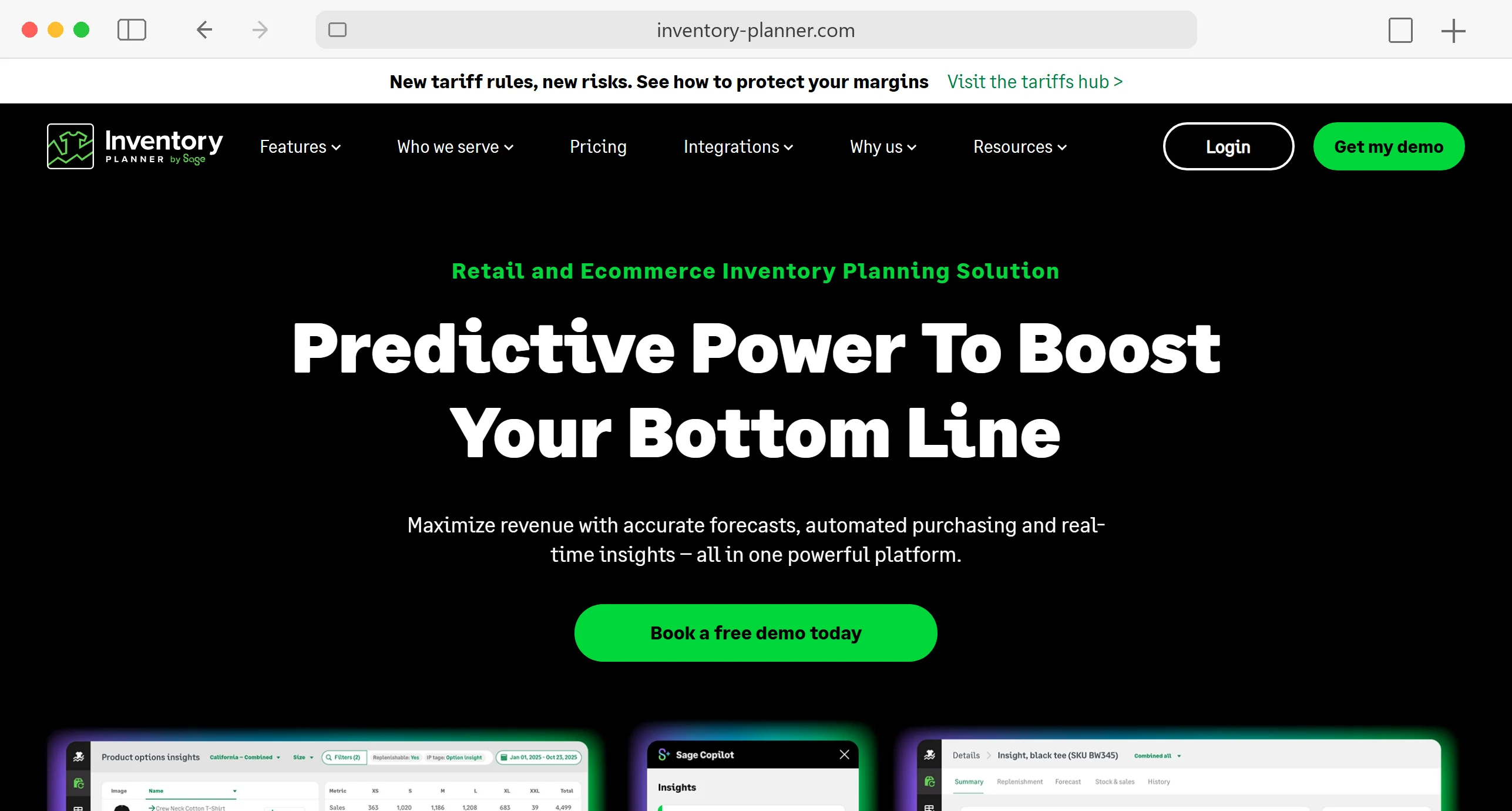
Inventory Planner, now part of Sage, is one of the best-known forecasting tools in e-commerce. It forecasts at SKU level across channels and warehouses, shows how each forecast is calculated, and includes open-to-buy planning for new products.
It connects to most of the big webshop platforms, including Shopify, WooCommerce, Adobe Commerce and Lightspeed, and to inventory systems such as Cin7 and Linnworks.
Website: inventory-planner.com
Best for: retailers that plan new-product buying against a budget, across several channels and warehouses.
Key features:
- SKU-level forecasting with transparent calculations.
- Open-to-buy planning, including new SKUs.
- Sage AI recommendations on what to order.
- Multi-location planning across warehouses.
- Connections to Shopify, WooCommerce, Adobe Commerce, Lightspeed, Amazon and NetSuite.
Keep in mind: Inventory Planner tells you what to order and when, and you then send the purchase order by email or through your inventory system. Expect several weeks of onboarding before you're live.
What users say about Inventory Planner: reviews on the Shopify App Store regularly mention helpful support staff and the time saved compared with spreadsheets. A few reviewers would like smoother data syncing between channels and warehouses, and more help with seasonal products.
8. RELEX Solutions: best for large retail chains
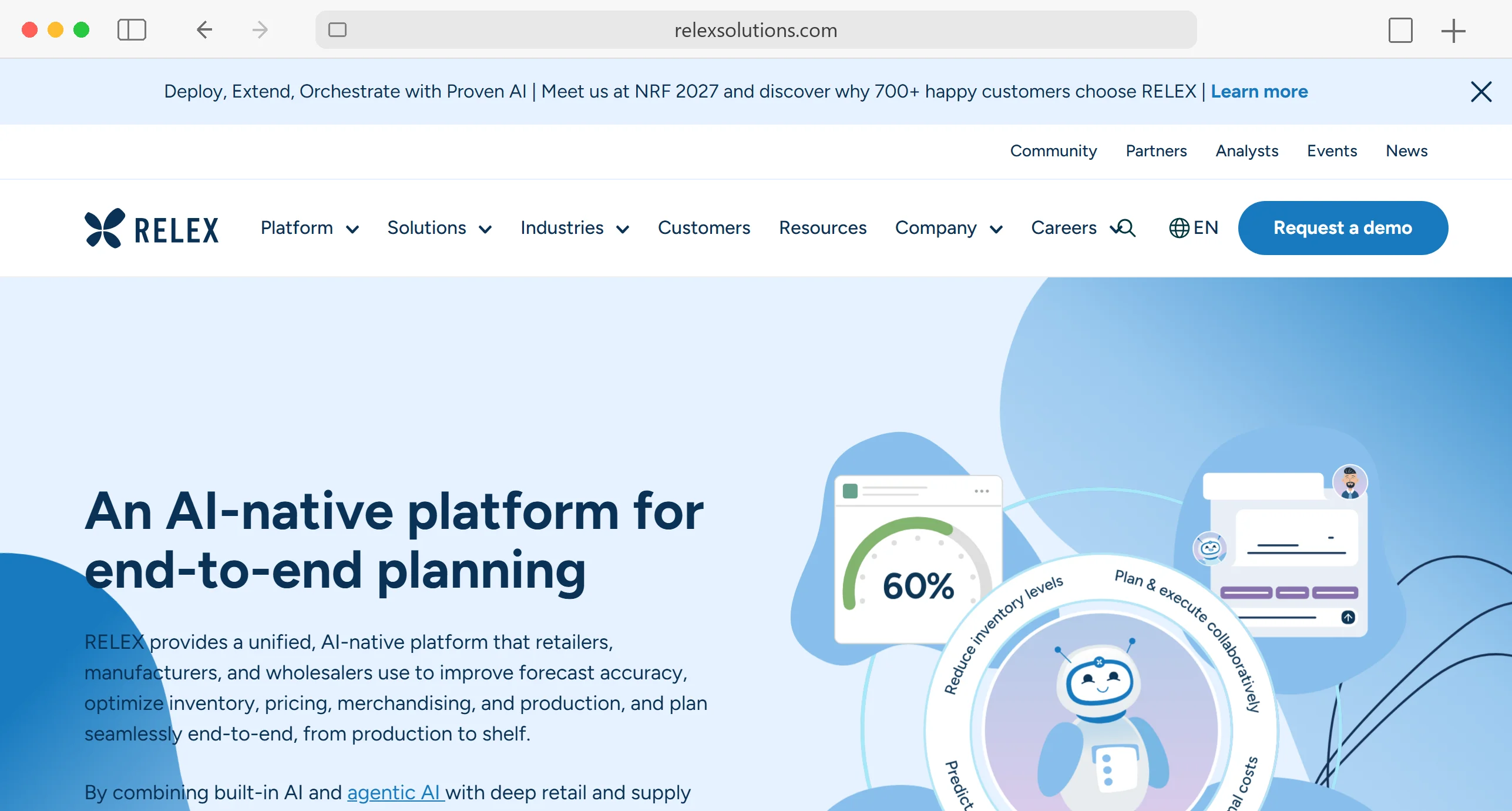
RELEX Solutions is an AI planning platform for large retailers, wholesalers and manufacturers, founded in Finland. Its machine learning forecasts factor in weekdays, prices, promotions, holidays, events and even the weather.
Replenishment runs automatically and corrects itself, with order proposals sent to your back-end system. RELEX works with major European retailers and has more than 700 enterprise implementations behind it.
Website: relexsolutions.com
Best for: large retail chains and wholesalers with complex store networks and a dedicated planning department.
Key features:
- Machine learning forecasts that include promotions, weather and events.
- Demand sensing for short-term changes.
- Automated, self-correcting replenishment.
- Fresh and shelf-life optimisation.
- Seasonal and promotion planning.
Keep in mind: RELEX is designed for large retail networks. For a webshop or mid-sized wholesaler, all that depth comes with a sizeable implementation project.
What users say about RELEX: reviewers on Gartner Peer Insights value its end-to-end coverage of planning and the partnership with the RELEX team. One recent reviewer notes that a rollout took longer than planned.
What should you look for in AI demand forecasting software?
McKinsey research found that AI-driven forecasting in supply chain management can cut forecast errors by 20% to 50% and reduce lost sales and product unavailability by up to 65%. Gains like that depend on the tool you choose and on how you buy, so check these five points before you book demos:
- Forecast method: does the tool test several models per product, or apply one formula to your whole assortment? Slow movers and seasonal products need different treatment. Our guide to improving forecast accuracy explains why.
- What happens after the forecast: a dashboard, a suggestion, a draft order or an order that goes to your supplier. Our overview of the best AI purchasing software covers tools that handle this step, which decides how much work stays on your buyers' desks.
- Supplier rules: MOQs, lead times, order moments and container sizes belong inside the tool, so nobody has to keep them in a spreadsheet on the side.
- Explainability: your team should be able to see why the tool wants to order something. Without that, nobody trusts the numbers.
- Your stack: check that the tool connects to your webshop, marketplaces and ERP, including the ones common in the Benelux, before you fall for a demo.
According to BCG, companies that forecast demand better can often cut 20% to 30% of their inventory and raise fill rates by three to seven percentage points.
Where AI demand forecasting pays off for online retailers
Optiply's supply chain agent takes the whole path from forecast to supplier order off your buyers' desks. Tackle Group Europe grew revenue by 20% with 3% less stock, and its entire purchasing is now run by two people.
Your buyers get their days back for supplier negotiations, new products and growth. Book a demo to see Optiply at work on your own data.
FAQ about AI demand forecasting software
How much sales history does AI demand forecasting software need?

AI demand forecasting software works best with at least 12 months of sales history per product, so the model has seen every season at least once. With two years of data, it can also tell a real seasonal pattern from a one-off peak. Less history still works, but forecasts for seasonal products stay rougher until a full cycle is in the data. Clean history matters as much as long history, so returns, stockouts and one-off bulk orders should be recognisable.
Can AI demand forecasting software predict demand for slow-moving products?
Yes, AI demand forecasting software can predict demand for slow movers, but only if it uses methods built for slow and irregular demand. A standard model averages long runs of zero sales into a misleading forecast. Good tools estimate both how often a product sells and how much sells when it does, using approaches such as Croston's method. Ask in a demo how the tool handles products that only sell a few times a month.
Do stockouts in your sales history distort an AI demand forecast?
Yes, stockouts distort an AI demand forecast when the software treats days without stock as days without demand. A product that was sold out for three weeks shows low sales, so an uncorrected model orders too little and the next stockout follows. Better AI demand forecasting software recognises stockout periods and estimates the demand you missed. Check whether a tool corrects for stockouts and promotions before it learns from your history.
Can AI demand forecasting software forecast demand per sales channel?
Some AI demand forecasting software forecasts demand per sales channel, while other tools only forecast total demand per product. Channel-level forecasts help when your webshop, marketplaces and B2B customers each follow their own pattern, or when stock is split across channels or warehouses. If you buy for one shared stock, a total forecast per product is often enough, as long as the tool reads the sales from every channel.
Is AI demand forecasting software suitable for wholesalers?
Yes, AI demand forecasting software suits wholesalers, provided it handles lumpy B2B demand and supplier rules such as MOQs, lead times and order moments. A single large customer order can distort a wholesale forecast, so the software should recognise those orders and treat them separately. Optiply is built for e-commerce and wholesale businesses: it forecasts demand per product and places the purchase order with the supplier, with those supplier rules built in.