



In summary
- An opaque recommendation forces the team to review it manually, which undermines the time savings that an automated replenishment tool is supposed to deliver.
- Transparency and accuracy go hand in hand: a correct recommendation that can't be explained has little operational value.
- When the logic is visible (recent demand, trend, available stock, lead time…), the recommendation builds real trust.
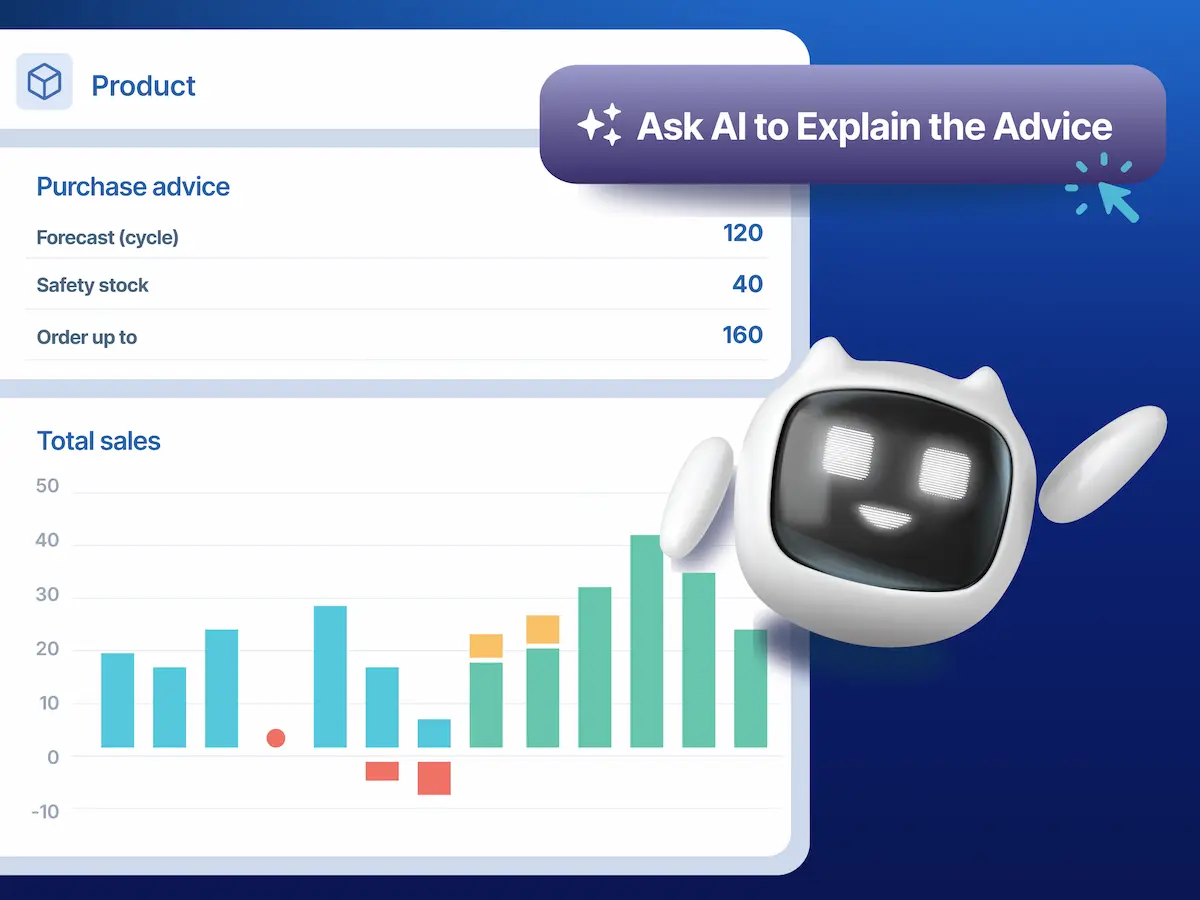
- Optiply shows the complete logic behind every purchase order recommendation.
- Travelbags reduced its order generation time by 80% after implementing Optiply. The transparency of the recommendations was one of the key factors in adoption.
The conversation that keeps repeating itself...
Why do so many purchasing managers end up ignoring the recommendations of their replenishment system, even when that system was acquired precisely to automate those decisions?
"The system told us to buy 100 units. I thought 50 was enough. But there was no explanation. Without understanding why, it was impossible to trust the recommendation. So we stopped using it."
This conversation repeats itself, in different words, and it is one of the most real and least visible problems in inventory management: the black box problem.
What is a black box recommendation
A black box recommendation is any system suggestion that does not come with a clear explanation.
The system says: "buy 100 units." But the purchasing manager doesn't know whether that quantity is based on recent demand, a growing trend, seasonality, stock in transit, the supplier's lead time, or a historical average from the last 90 days.
The problem isn't just that they don't understand the number. It's that, without an explanation, they also can't tell when the system isn't taking all relevant factors into account.
The three possible ways out — none of them good
When an experienced purchasing manager sees a recommendation that doesn't align with their market knowledge, they have three options:
- Follow it blindly and accept the consequences if it fails.
- Ignore it and fall back on their instincts, negating the value of the system.
- Manually investigate what the system should have explained from the start — which eliminates one of the main arguments for having the tool in the first place: time savings.
None of the three options is good.
And the result, in most cases, is that the purchasing manager stops trusting the tool. A tool that doesn't inspire trust doesn't get used.
Why transparency matters as much as accuracy
A correct recommendation that the purchasing manager cannot verify has little operational value.
A good purchasing tool shouldn't just tell you how much to buy. It should help the purchasing manager understand why that quantity makes sense right now, for this product, with this supplier.
That means showing the data behind every suggestion: recent demand, trend, available stock, pending stock yet to be received, coverage with and without the purchase, lead time, and the product's historical behaviour.
When this logic is visible, the recommendation stops being a black box and becomes a reasoned decision.
The six questions every purchasing manager asks before approving an order
Before approving an order, every experienced purchasing manager asks the same questions:
- How much have we sold in the last few weeks?
- Is demand going up, down, or staying stable?
- How much stock do we have available right now?
- Is there stock already ordered that hasn't arrived yet?
- What coverage will we have with this purchase — and without it?
- Why does the system recommend 100 units and not 50 or 200?
A tool that answers these questions in seconds radically changes how the purchasing team works.
A tool that can't answer them creates friction with every decision.
How adoption changes when the logic is visible
Travelbags reduced its order generation time by 80% after implementing Optiply. One of the factors that most influenced that figure was precisely the transparency of the recommendations: the purchasing team could see, for every suggestion, the data behind it.
When the purchasing manager understands why the system recommends a specific quantity, they can approve routine decisions faster, identify exceptions without reviewing the entire catalogue, and apply their expertise where it's truly needed: new products, supplier negotiations, one-off commercial constraints…
The purchasing manager stops acting as a manual operator and becomes a true purchasing manager in every sense of the word.
What makes Optiply different on this point
At Optiply, purchase recommendations are designed to be understandable from day one. Transparency is one of the core principles on which the Optiply platform is built — and the first thing any purchasing manager should demand from their automated replenishment tool.
The purchasing manager can see the logic behind every suggestion. We provide a clear, data-driven recommendation, accompanied by the context needed to decide with confidence.
Purchasing automation doesn't mean a loss of control for the purchasing team. Quite the opposite — it enables greater control and efficiency with less manual effort.
If your purchasing system can't justify a recommendation, you don't just have a trust problem. You have a solution problem.
Ready to see how this works with your own data? Book a demo and we'll show you the logic behind every recommendation, using your own products and your own suppliers.
Answers to frequently asked questions



.webp)