


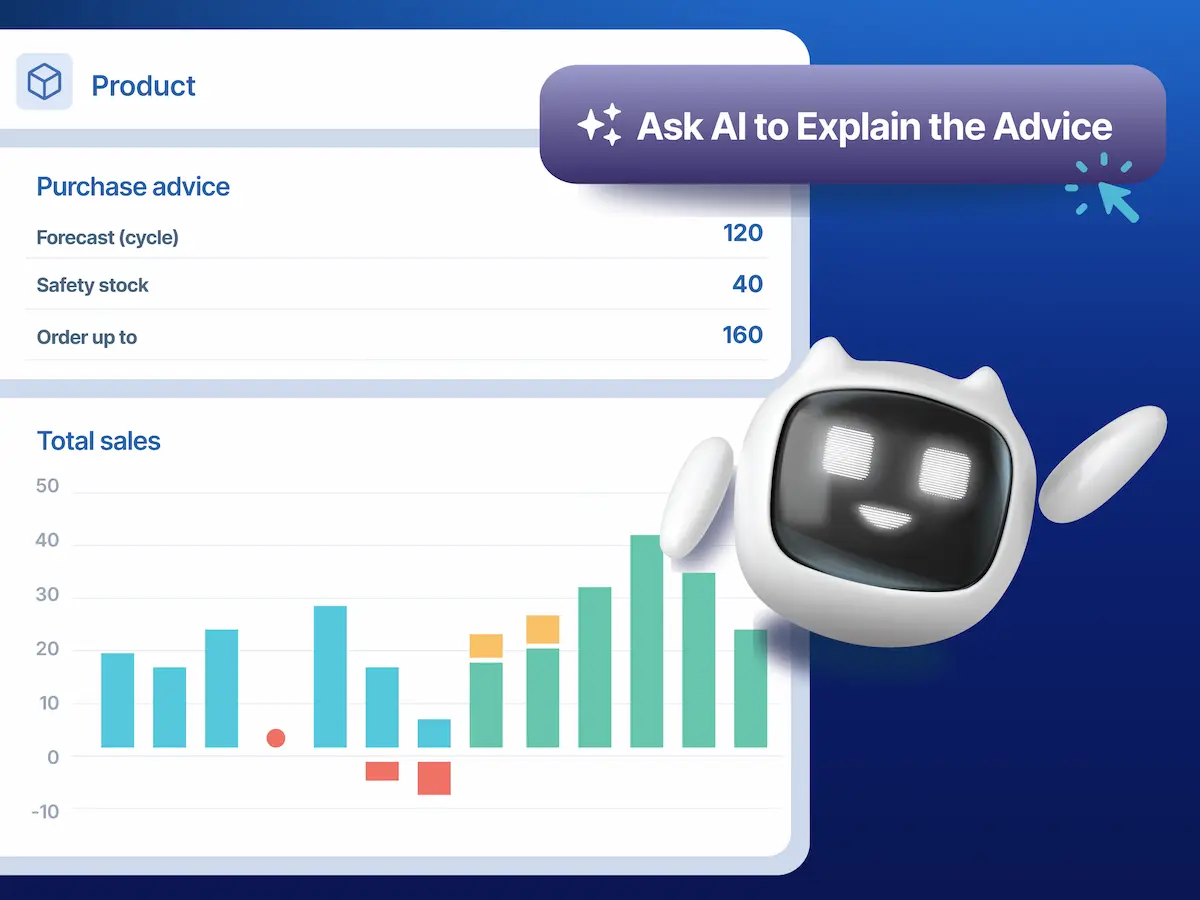
In short
- A supply chain agent is AI that works on your live stock, sales and supplier data and carries out tasks with your approval. Optiply's Supply Chain Agent is built for purchasing and inventory automation.
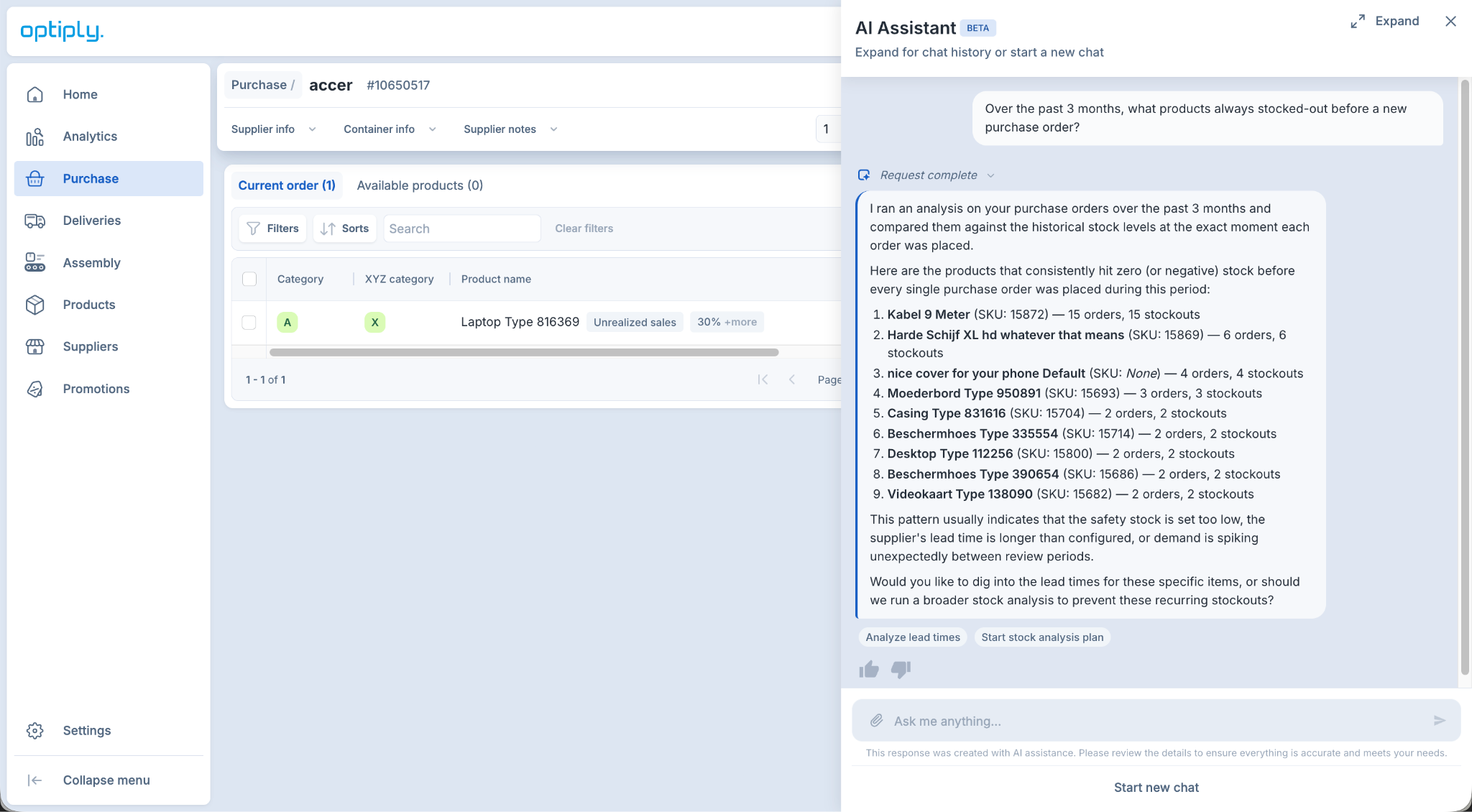
- It talks to your data in plain language, makes configuration changes once you approve them, runs service-level simulations, guides you through action plans, reconciles supplier invoices and remembers your preferences across sessions.
- Where a chatbot answers what you ask, the agent also analyses your data and runs the alerts you've approved, for example on suppliers whose real delivery times differ from the lead times you've set.
- Every action needs your explicit confirmation. Next up: more proactive insights that link an issue to its stockout risk per SKU and a proposed fix.
Meet Optiply's Supply Chain Agent
Inventory optimisation software has been around for decades, and most of it has the same fundamental limitation: it tells you what to do, but it can't help you do it.
Until recently, that wasn't possible without considerable hallucinations. Thanks to the latest AI models that are now faster, more affordable and accurate enough to be genuinely useful in a business setting, that's finally become a reality.
For us, that made possible something we'd been building towards for ten years: all the ERP, WMS, or e-commerce integrations, and inventory, demand, and supplier data across multiple systems, now with an agent on top that can actually use it. It's the closest thing to a supply chain specialist working inside your software.
When we set out to build Optiply's Supply Chain Agent, we had a clear set of goals in mind. We wanted to build an agent that could:
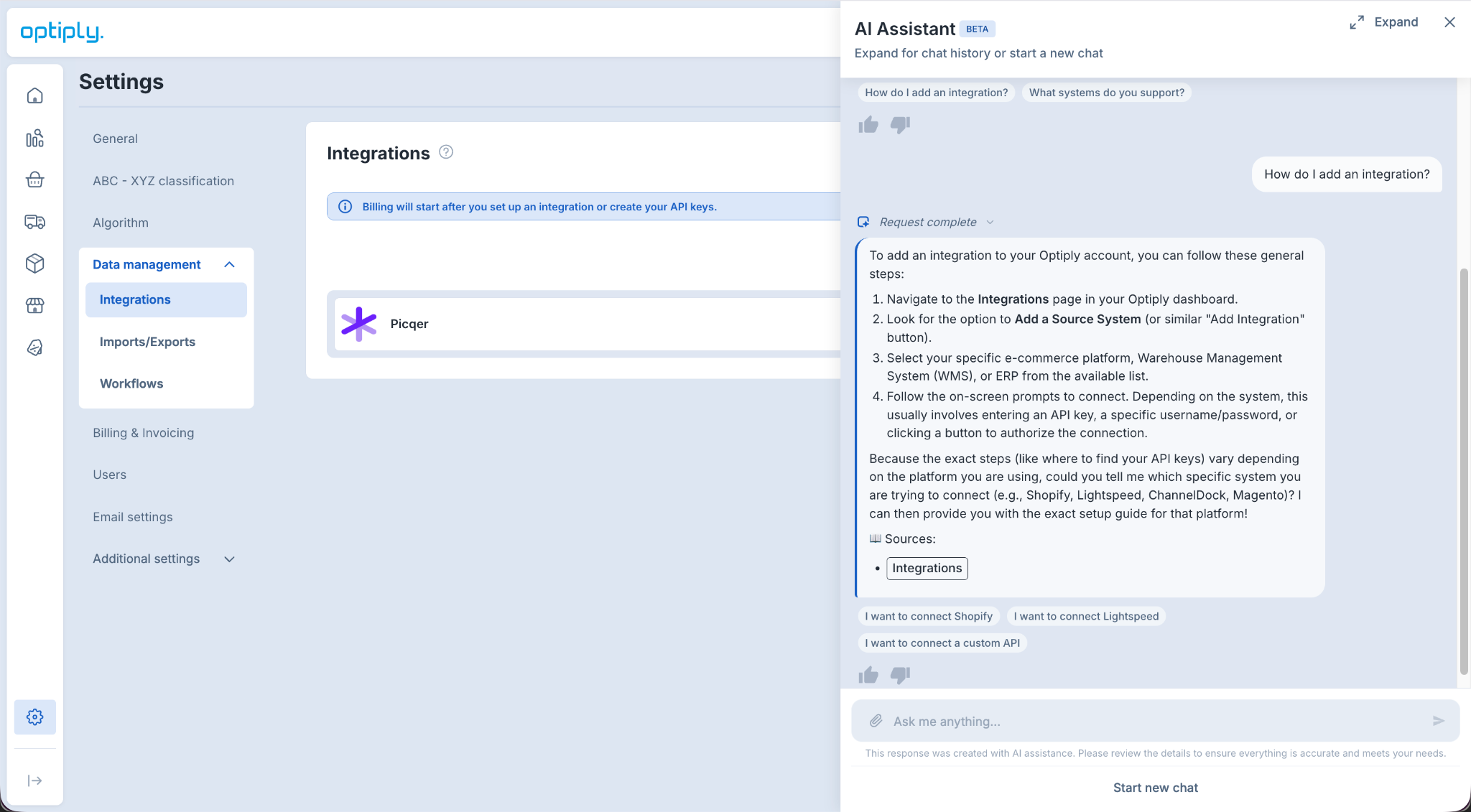
- Talk to your supply chain data in plain language, without needing a specialist to interpret the output.
- Execute tasks on your behalf, from updating supplier lead times to working through a structured improvement plan.
- Flag problems before you have to go looking for them, so your team stays ahead rather than catching up.
- Learn from your business over time, remembering past decisions, preferences, and context from every interaction.
We believe we've achieved this. The agent connects directly to your existing data and integrations, so there's no lengthy setup or data migration. It also keeps running in the background, with nightly runs and integrations that keep working, so it always starts from current numbers.
From day one, it knows your suppliers, your stock positions, your ERP systems and your history with us.
It can hold a conversation across multiple turns, understand follow-up questions and adjust its reasoning as your needs become clearer. And because it's built on ten years of real supply chain data and thousands of customer support conversations, it understands the domain in a way that a general-purpose AI tool can't replicate.
We keep developing the agent, adding new capabilities as the underlying models improve. Further on, we're specific about its current limitations and what's next on the roadmap, so you know exactly what it can take off your team's plate today.
How we built the agent, and why we keep improving it
We started with a multi-agent architecture: a team of specialists, each with a single task. One for data quality, one for inventory strategy, one for purchase orders, and one that remembered your corrections. The main reason was reliability. An agent with one clear task makes fewer mistakes than a single model that has to choose from twenty tools.
With the latest model generation, that no longer holds. A team of agents now mostly means more handovers, more context to pass around, and more places where things go wrong. So we flipped it. Now a single agent does everything, with a model smart enough to pick the right tool on its own.
As Sander van den Broek, Co-Founder, puts it:
"It's the biggest lesson from building production AI: you don't optimise your architecture, you keep throwing it away. Every model generation moves the goalposts. That's exactly why the agent keeps pace with what the latest models can handle."
On top of that, the agent is trained on something no new competitor can replicate. Ten years of customer conversations produced a detailed picture of which problems come up most, which questions buyers actually ask, and what good answers look like in practice.
How is a supply chain agent different from other AI tools?
A lot of supply chain software now claims to have AI. Most of it means one of two things: a machine learning forecasting model that has been there for decades, or a chat interface layered on top of existing functionality that can't change anything in your system. Gartner calls this "agent washing", and estimates that only about 130 of the thousands of vendors selling agentic AI offer the real thing.
"Chatbots give you answers, the Supply Chain Agent actually gets things done for you." - Sander van den Broek, Co-Founder Optiply
The table below shows what that looks like in practice.
| General-purpose AI | Optiply Agent | |
|---|---|---|
| Data access | You upload your data manually, per session | Live access to your full supply chain data at all times |
| Context | You craft the prompt and provide the context | Knows your ERP mappings, supplier history, and where you are in the application |
| Action | You interpret the output and act in your system yourself | Makes changes in Optiply with your approval |
| Monitoring | Responds when asked | Runs the alerts and reports you've scheduled, and checks your data for issues like lead-time drift |
| Example (illustrative) | "Here is what I found based on the file you uploaded" | "This supplier's lead time has been drifting for three weeks. It will cause a two-day stockout on SKU #4821. Shall I update it?" |
These are the kinds of issues a consultant might catch in a quarterly review. The agent catches them on a random Tuesday morning.
Curious how the Supply Chain Agent optimises your inventory? Book a demo and see what it can do with your stock, suppliers and systems, right from day one.
How does the agent know what to recommend and when to stop?
It's still hard to fully trust AI today, and we understand that. That's why we built the Supply Chain Agent to give reliable advice and carry it out, but always within the boundaries you set.
Reliable data
The agent's intelligence comes from three places:
- Your live data
- A continuously updated memory built from every interaction your team has with ours
- Context from over a thousand daily users
When you speak with our customer success team and agree that reducing overstock is the priority for Q2, the agent has that context the next day.
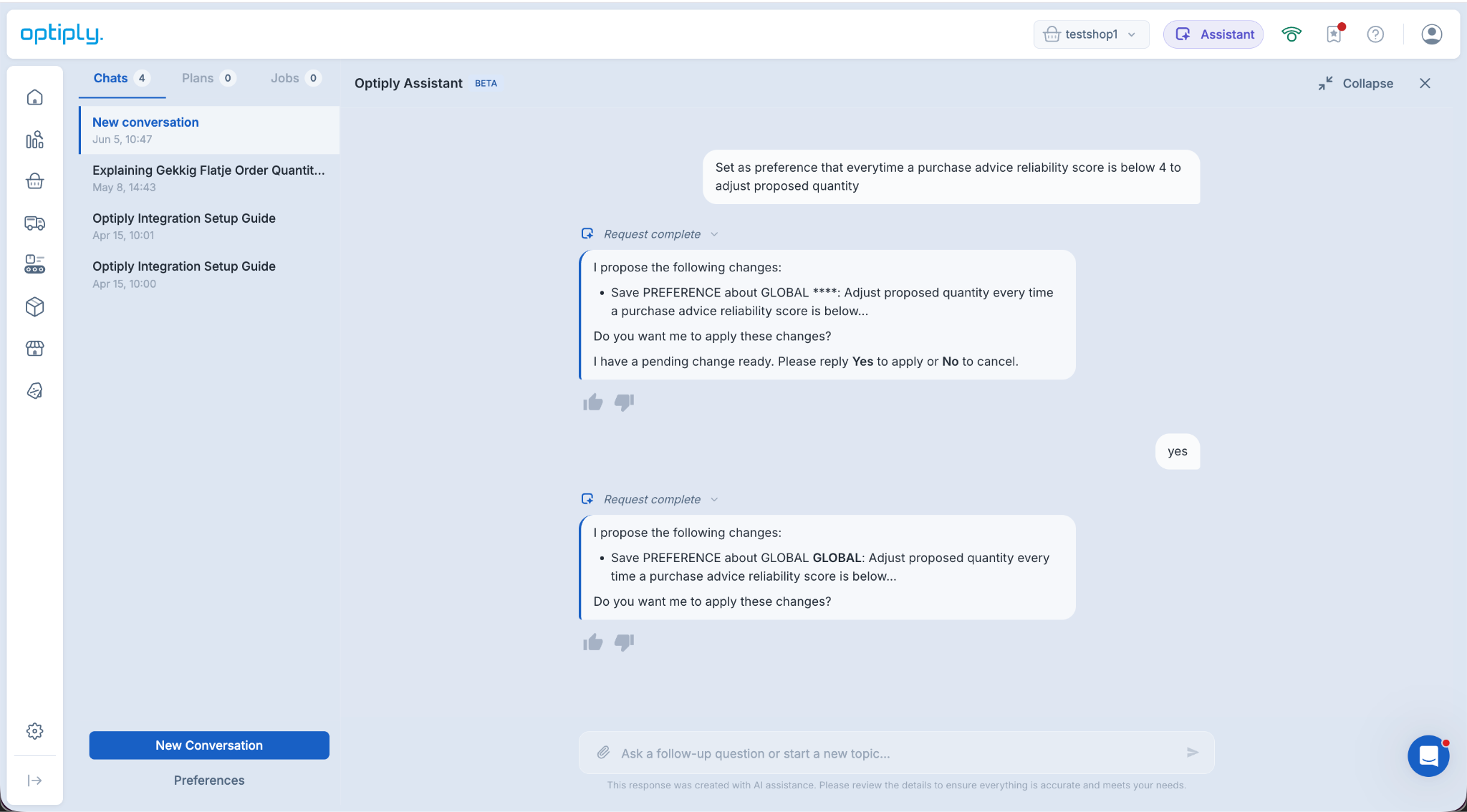
When you tell it to refer to suppliers by their Optiply IDs rather than their names during a presentation, it stores that as a preference and applies it in every subsequent session until you change it. It doesn't start from scratch every time you log in.
Staying in control
The most common concern we hear from customers is about trust. Letting software act on your behalf in a purchasing context is a significant decision, and we're not going to pretend otherwise.
The calculations run automatically, and the decision stays yours. For now, every action the agent wants to take requires your explicit confirmation. It tells you what it intends to do, and nothing happens until you approve it. In practice, it looks as simple as this: "I'll update the lead time. Go ahead?" Only when you say yes does it carry it out. That's a hard boundary, and it's not moving in the near term.
Over time, customers will be able to define their own thresholds, such as the maximum value of a purchase order the agent can raise autonomously, or the acceptable deviation from a previously agreed replenishment strategy, so that the degree of autonomy reflects the degree of trust you have built with the system.
There's also a second feedback loop running in the background. When the agent generates a new improvement plan for a customer, it first routes that plan to one of our own supply chain specialists for review before it's shown to you.
That expert can approve it, adjust it, or reject it, and whatever they decide, the agent learns from it. It's how we ensure that the agent's judgement improves continuously rather than drifting.
Where we're still improving
We want to be upfront about what the agent doesn't do well yet, because some of these limitations will matter more to some teams than others.
Speed
First of all, the agent's responses aren't instant. It's doing real work: querying live data, cross-referencing multiple sources and reasoning through the implications before it responds.
That takes a few seconds longer than a keyword search, and in some cases longer still. We have optimised for accuracy over speed, because in a purchasing context, a fast wrong answer is worse than a slower correct one.
Accuracy
The agent can make mistakes. It occasionally misreads context, particularly in edge cases that fall outside the patterns it has been trained on.
The failure mode here is different from a conventional software rule: rather than returning no answer or an irrelevant one, it may return a plausible-sounding answer that's wrong.
We have a feedback loop built in so that errors are captured and used to improve the model, and we label agent responses clearly so your team always knows they're interacting with AI.
Finally, we're confident that for most supply chain teams, the agent's accuracy is already above the threshold where it adds more value than it introduces risk. And we expect that threshold to keep rising.
Models are improving with every generation, and we're learning from real usage every week. The version available today is already meaningfully better than what we were testing six months ago.
Pricing
Pricing is also something we're still working through. Adding an agent that can actively reduce overstock, prevent stockouts, and replace hours of consultant time doesn't map cleanly onto a per-user or per-feature model.
Our current thinking is that the core agent should be part of your existing Optiply plan, since it makes everything else in the product more valuable. Capabilities that go beyond that, like automated supplier communication or autonomous order placement, will likely be priced separately.
But we want to be honest: we don't have all the answers here yet, and we would rather get the pricing right than rush it.
What can Optiply's Supply Chain Agent do today, and what's next?
You can try the Supply Chain Agent today. At the moment, this is what it can do:
- Give you live conversational access to your supply chain data.
- Analyse your lead times, comparing the lead times you've configured with actual delivery times and showing which suppliers differ most.
- Help with configuration changes like correcting a supplier's lead time, with your approval required before anything is committed.
- Run Optiply's service-level simulator for one to three scenarios, showing the effect on stock value, investment and margin without applying any new targets.
- Run the scheduled reports and conditional alerts you've approved.
- Guide you through structured, multistep action plans, for complex processes like onboarding that would otherwise require a specialist, or for plans you set up yourself.
- Reconcile supplier invoices against purchase orders and deliveries with 3-way matching, flagging price, quantity and total differences before you pay.
- Work across Dutch, English, and Spanish, trained on the specific terminology we use in the application so it understands that "transit time" and "lead time" are the same thing in your context.
- Respect your ERP mapping, so it doesn't overwrite fields your source system manages. If you ask it to change a supplier name that comes from your ERP, for example, it deliberately won't, and it explains why. Even support can't always make that distinction.
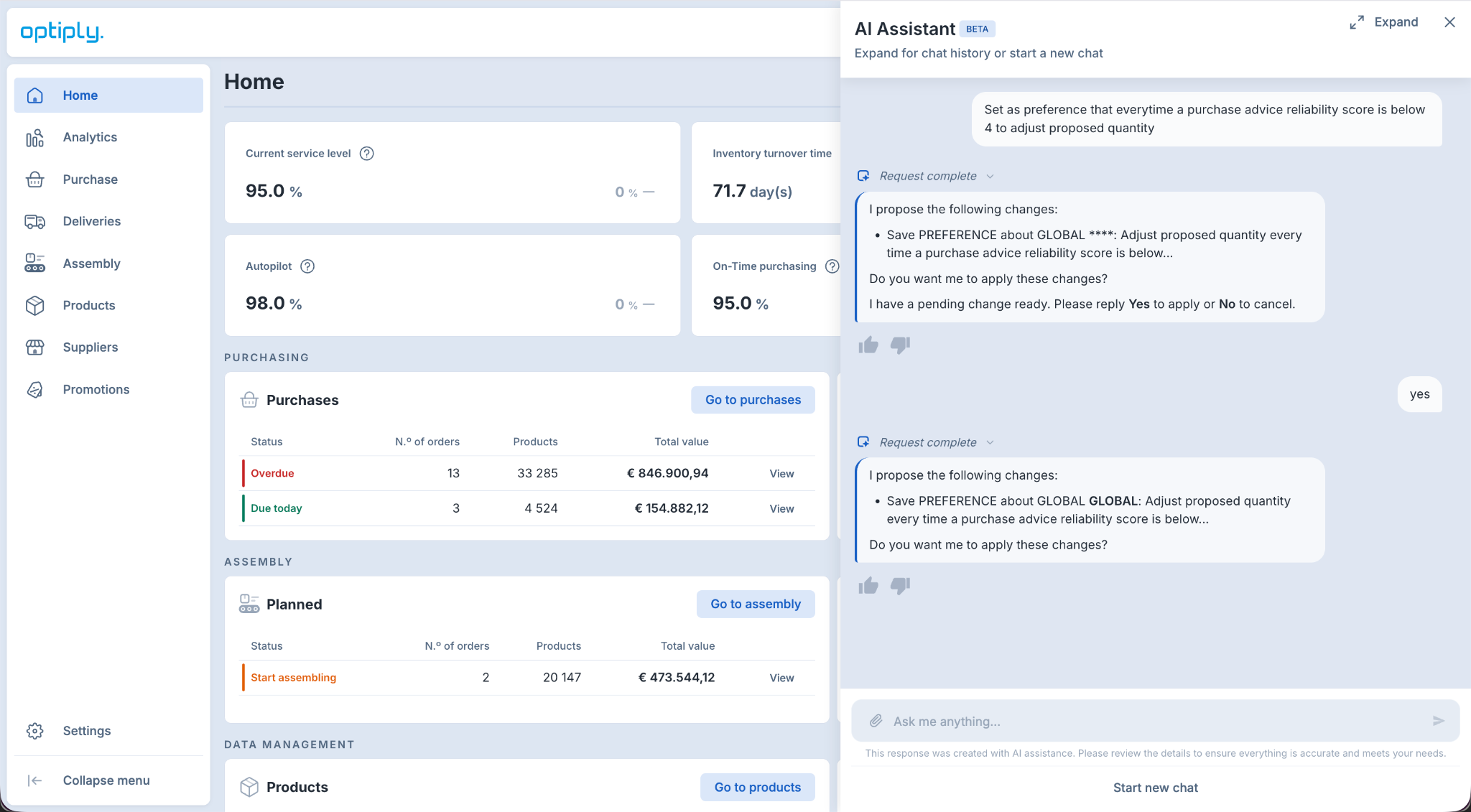
- Remember your preferences across sessions, so it gets more useful the longer you use it.
The next step is making these insights more proactive. Lead-time analysis already shows which suppliers are off, and we're connecting that to quantified stockout risk per SKU and a proposed action, so the agent raises the issue before you go looking for it. More autonomous workflows and a deeper understanding of your business context are a longer-term direction.
Where supply chain is going
The near-term opportunity is augmentation, not replacement. A purchaser who uses these tools well will outperform a fully automated system, because they can negotiate terms, build supplier relationships, and make judgement calls that no agent will be permitted to make.
A purchaser who doesn't use these tools will struggle to compete with one who does. That gap is going to widen quickly: Gartner expects at least 15% of day-to-day work decisions to be made autonomously through agentic AI by 2028, up from 0% in 2024. The same goes for the strategic work that still sits with external consultants. Much of it moves at the speed of a PowerPoint, not at the speed of your business.
The agent keeps your strategy up to date as targets shift and data ages. Optiply's vision has been the same since day one: a supply chain run by algorithms, steered by people.
See the Supply Chain Agent work on your own data
Optiply's Supply Chain Agent connects to your live stock, sales and supplier data, answers your questions in plain language and makes purchasing changes as soon as you approve them, so your team spends its time on suppliers and judgement calls. See how the Supply Chain Agent runs replenishment, or book a demo and ask it about your own stock.
Frequently asked questions about the supply chain agent
What is a supply chain agent?

A supply chain agent is AI software that connects to your live purchasing, inventory and supplier data, reasons about it and carries out tasks once a person approves them. Think of correcting a supplier's lead time after comparing it with actual deliveries, or working through a plan to reduce overstock. That's the difference with a chatbot, which only answers the questions you type in and leaves every change to you. Optiply's Supply Chain Agent is built for purchasing and inventory automation, on top of the integrations and data Optiply already holds for each customer.
What does an AI supply chain agent do?
In purchasing and inventory, an AI supply chain agent answers questions, analyses data, makes changes and remembers context. It answers questions about stock, sales and suppliers in plain language, and it analyses your data, for example by comparing configured lead times with actual delivery times to show which suppliers differ most. It makes changes, such as updating settings, once you approve them, and it remembers your decisions and preferences so it doesn't start from scratch next time. Optiply's agent can also run service-level simulations and reconcile supplier invoices with 3-way matching.
What is agentic AI in supply chain?
Agentic AI in supply chain means AI systems that can plan and carry out multistep tasks across purchasing, inventory and logistics, on top of generating answers or forecasts. Gartner expects 33% of enterprise software applications to include agentic AI by 2028, up from less than 1% in 2024. A practical test when you compare tools is to ask whether the AI can make a change in your system with your approval, or only describe what you should do.
What data does a supply chain agent need?
A supply chain agent needs live access to your stock levels, sales history, supplier data such as lead times and minimum order quantities, and your open purchase orders and deliveries. The more complete that data is, the more useful its analysis gets: comparing configured lead times with real delivery times only works when delivery dates are recorded. Optiply's agent uses the data that's already connected through Optiply's 50+ ERP, WMS and e-commerce integrations, so you don't upload files per session.
Will a supply chain agent replace buyers?
No, a supply chain agent takes over routine checks and changes, while buyers keep supplier negotiations, relationships and judgement calls. In Optiply, every action the agent proposes needs a person's explicit confirmation, and new improvement plans are first reviewed by one of Optiply's own supply chain specialists. The bigger shift is between teams: buyers who use an agent well will be able to handle more suppliers and products than buyers who don't.



.webp)