



In short
- The Supply Chain Agent covers the whole replenishment loop, from forecasting and deciding to ordering, confirming, receiving, and reconciling.
- It works from your own supply chain data, ten years of customer conversations, and Optiply's forecast engine, rather than general assumptions.
- Today it can explain overstock and revenue swings in plain language, catch data errors, place and confirm orders with your approval, monitor suppliers over time, and reconcile invoices through 3-Way Matching.
- Every sensitive action waits for your sign-off, customer data stays isolated, and the agent hands it off to a human expert when it's unsure.
- Some customers already manage around 90,000 SKUs with a single person on purchasing, which shows capacity doesn't have to scale with headcount.
From advice to action: closing the whole replenishment loop
Most inventory optimisation software tells you what to do and then waits for a person. It flags an exception, suggests the purchase quantity, and stops. Deciding what to buy, though, is only step one of the work.
The full loop includes forecasting, making the right decision, ordering, confirming, receiving, and last but not least, reconciling. Old tools stop at the “decide” stage. The agent is built to close the rest of the loop, from placing orders and chasing confirmations to receiving goods and reconciling invoices. That shift, from a tool that advises to an agent that acts, is the whole point.
Why you can trust the agent as your supply chain expert
A lot of software now claims to have AI. Usually it means that these tools offer a forecasting model that has been there for years, or a chat window bolted on top of the existing software that can’t change anything in your system. The Supply Chain Agent is different because of what sits underneath it.
These five things give the agent its edge:
- Ten years of data of real customer chats and email communication about how supply chain problems actually get raised and solved, at scale.
- Your full supply chain gets normalised: every SKU, supplier, lead time, and sale, readable in an easy-to-understand query.
- The Optiply forecast engine, called as a tool. It doesn’t guess quantities, instead it uses accurate data to calculate them.
- An execution layer of EDI and supplier-portal connections, so it can place and confirm orders rather than only describe them.
- Curated, sourced supply chain expertise, grounded in facts instead of the open web.
The easiest way to explain the difference is that a general-purpose chatbot answers stuff for you, while the agent executes things for you.
Now let’s have a look at the things the agent can fix for you to get to 100% automated replenishment. Every example below is real, taken from anonymised customer conversations with the agent. We are also honest about where it still falls short.
Five things the agent can arrange for your procurement team
1. Answer and diagnose issues in plain language
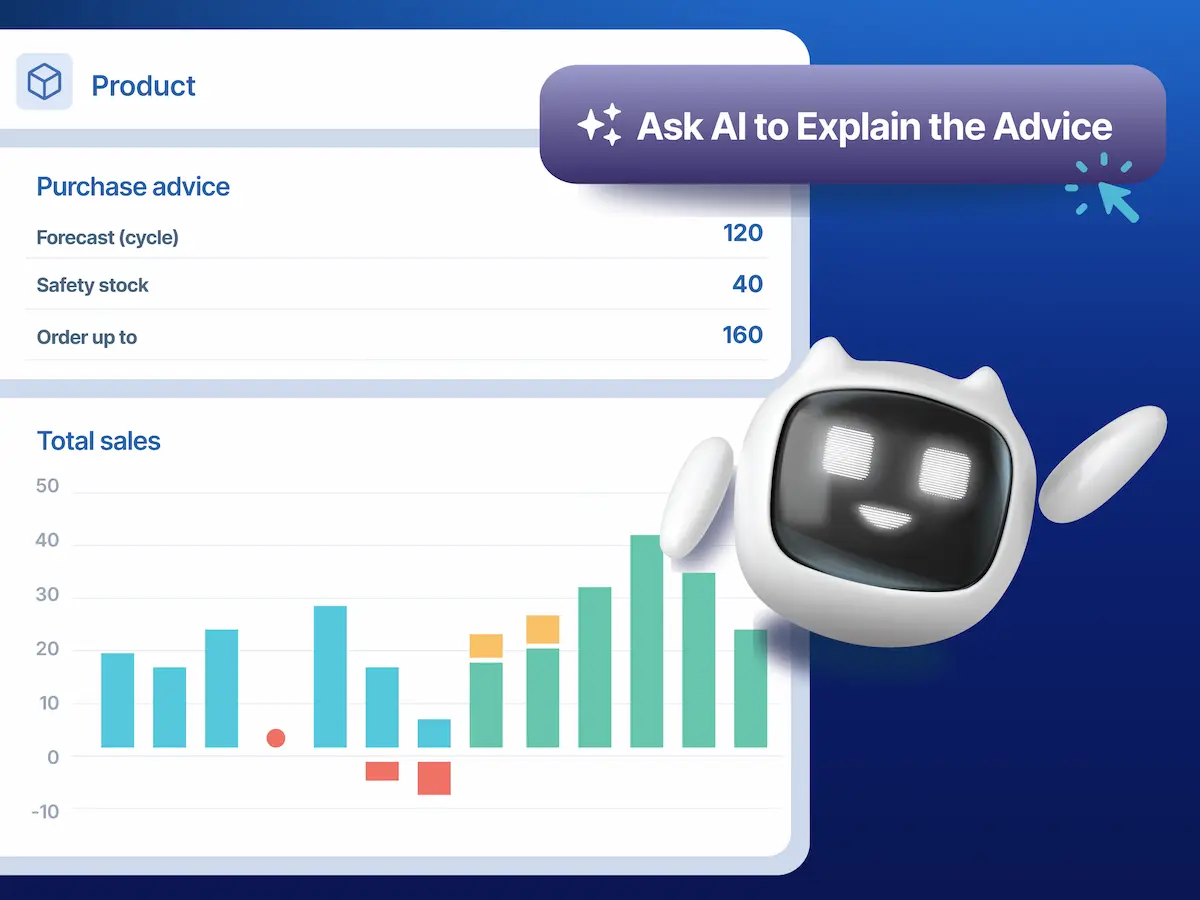
Ask a question the way you would ask a colleague, and you get an expert answer with the reasoning attached. "Is the current overstock mostly from orders I placed without Optiply's advice?" got a split in seconds: of roughly 1.68 million euros in overstock, about 91.5% traced back to manual orders and only 8.5% to advised ones.
It also knows the rules, explaining that a supplier's MOQ always overrules the calculated EOQ, and it pushes back when you’re right, once catching a contradiction between two help articles instead of playing yes-man.

2. Catch data errors
Bad data quietly breaks good forecasts. One customer asked why their annual revenue read €201,289,864. The agent traced the spike to a handful of outlier orders above €50,000, exported them for review, and a session later confirmed the corrected figure of €9,676,643 was stable.
3. Act on your systems, with your approval
The agent carries out the work, and every sensitive action waits for your sign-off. Given a 50% supplier discount on a SKU, it recommended 25 units, noted the price drop from 2.00 to 1.00 euro, and offered to update the purchase price.
Asked to switch on backorders across 100-plus suppliers, it worked in approved batches and returned a CSV of the 36 active ones. When it was told to fix a supplier's lead time, it capped an impossible 485-day reading at the 365-day maximum and drafted the email.
4. Remember and monitor
It remembers context across sessions, so it gets more useful the longer you use it. After that lead-time fix, the customer asked it to track the supplier monthly. The agent scheduled a recurring task that checks the deviation and sends a summary, no reminder needed.
5. Reconcile your invoices with 3-Way Matching
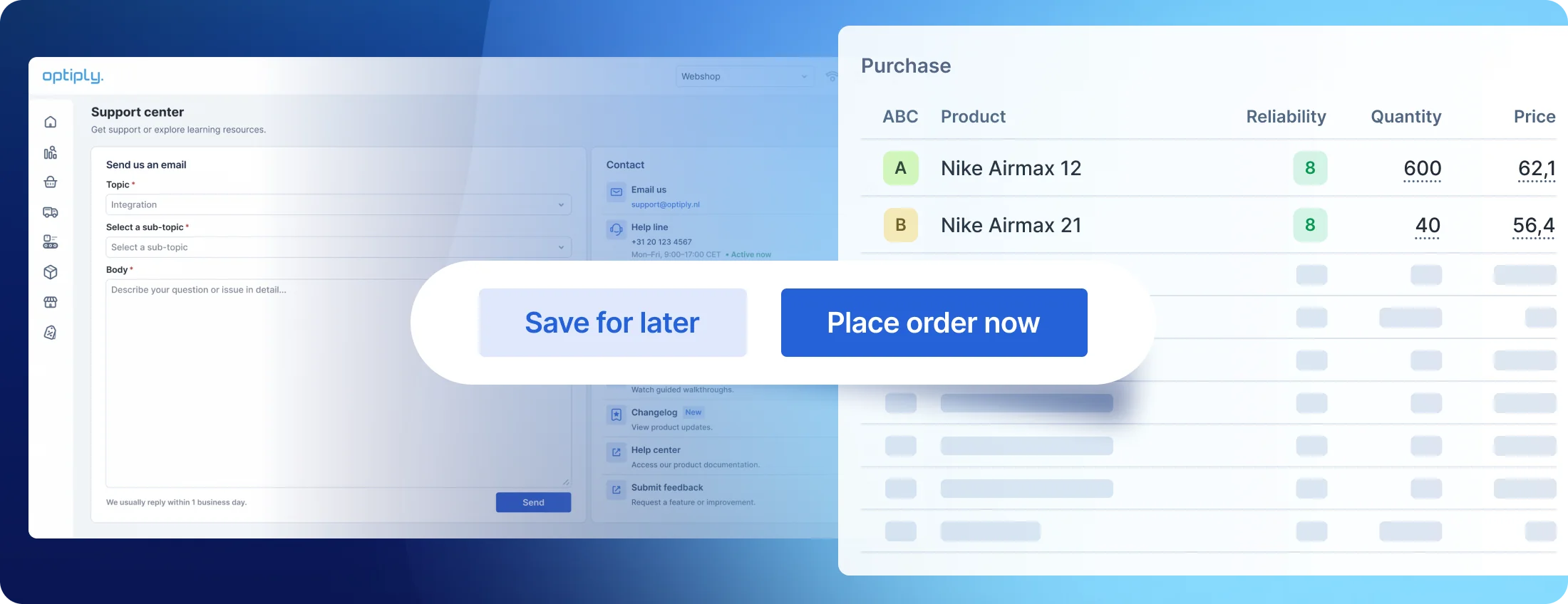
At the “reconcile” end of the loop, 3-Way Matching lines up what you ordered, what arrived, and what you were billed, then flags every discrepancy before you pay. It catches a price gap or a quantity mismatch, totals the cost, and drafts the correction email. This is work some teams still assign a person to, and it’s open to every customer in public beta now.

Sander, our Co-Founder at Optiply, highlights:
“It's the biggest lesson from building production AI. You don't optimise your architecture; you keep throwing it away. Every model generation moves the goalposts. That's exactly why the agent keeps pace with what the latest models can handle.”
Scaling demand planning without scaling headcount
For decades, the depth of your planning was capped by who you could hire. Proper supply chain management scaled with headcount.
An agent puts that expertise on every team instead. Capacity stops scaling with headcount and is suddenly there for everyone. Optiply’s best-run customers manage around 90,000 SKUs with a single person on purchasing, roughly eight times what a conventional team handles on the same assortment.
The biggest opportunity right now is augmentation. A buyer who uses these tools well will outperform both a fully manual team and a fully automated one, because they can still negotiate terms, build supplier relationships, and make the judgement calls no agent should make.
Automate replenishment while staying in control
Automation only earns its keep if you can still trust what it does on your behalf. The agent can see your whole business in a single query, but it’s deliberately cautious about acting on it. You approve everything and feedback becomes a new ground rule.
The agent proposes and advises, and nothing will be ordered or changed until you say yes. Your data stays yours, with every customer fully isolated, so the agent only ever sees what’s happening at your business. When it’s unsure or gets stuck, it hands it off to an Optiply expert rather than guessing. And it works in English, Dutch, and Spanish, so the whole team can use it.
What the Supply Chain Agent can fix today, and what comes next
The Supply Chain Agent is live for every Optiply customer right now. There’s no waitlist and nothing to install. It’s already on your account, pointed at your data, so you just log in and start with a real question from this week. It learns your context as you go, with no onboarding marathon.
Next on the roadmap are more proactive alerts that surface issues before you ask, deeper purchasing automation, and more languages.
Optimise inventory with the AI agent you can trust
Optiply’s Supply Chain Agent reads your live data, explains the reasoning behind every recommendation, catches data issues, takes action on your systems with your approval, remembers what matters, and now reconciles your invoices through 3-Way Matching. It closes the replenishment loop from end to end, while you stay in control.
The expertise was always in your data. Now you can simply ask for it.
Log in to Optiply and ask the agent something today, or book a demo to see it work with your own suppliers, stock, and systems to move to 100% automated replenishment.
Answers to frequently asked questions


.webp)