


.webp)
In short
- Purchasing software helps e-commerce and wholesale teams cut backorders, reduce manual order-chasing and free up buyer time by replacing manual supplier management with automated replenishment.
- The top solutions differ mainly in automation depth, supplier complexity handling, ERP fit and how much they explain their decisions.
- When choosing a platform, look at your ideal balance between automation and control, how many suppliers and MOQs you manage, how fast you want to implement, how well it fits your existing systems, and whether it can scale with your assortment and supplier base.
- Customers switching to Optiply see it in the numbers: Travelbags cut daily purchasing time from about 5 hours to 1-1.5 hours, and Mastertools cut backorders in half while reducing inventory by 20%.
How we evaluated the best AI purchasing software
We looked at public product pages, user reviews (G2, Capterra, Software Advice, Gartner Peer Insights) and independent technical reviews, then ran our own hands-on comparison of each tool's purchasing workflow against four criteria:
- Automation depth: does it recommend an order, or place it?
- Supplier complexity: can it handle multiple suppliers, MOQs and order windows without manual mapping?
- ERP fit: does it connect to the systems e-commerce and wholesale businesses actually run, or only to its own ecosystem?
- Explainability: does it show the person using it why a decision was made, not just what the decision was?
That last one is the criterion most "best purchasing software" roundups skip entirely. In our experience working with demand planning and purchasing teams, we see it's the one that decides whether a tool is still being used six months after the trial ends.
That's not just a hunch. McKinsey found that only 60% of large companies and 30% of small ones have fully implemented procure-to-pay platforms, even though McKinsey also estimates agentic AI could make procurement operations 25-40% more efficient once it's past the pilot stage.
That adoption gap comes down to trust in the recommendation, not the underlying technology. A buyer who can't see why a tool ordered 400 units instead of 250 will quietly go back to doing it by hand, however accurate the model actually is. Explainability is what keeps that trust intact past the pilot stage, which is exactly why it's one of our four evaluation criteria, not an afterthought.
The 5 best AI purchasing software tools for e-commerce and wholesale teams
With that in mind, here's how the five tools we evaluated compare.
1. Optiply
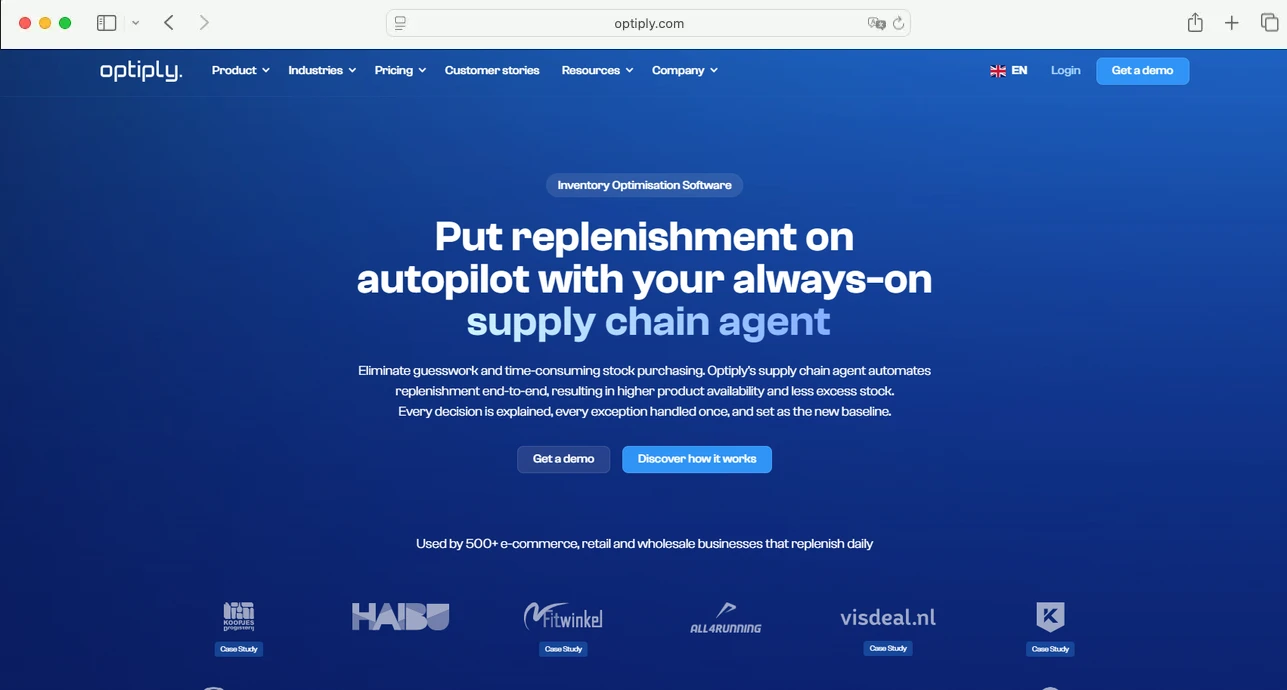
Best for e-commerce, retail and wholesale businesses that replenish daily
Full disclosure: yes, that's us. Optiply is an AI-powered purchasing agent built for fast-moving e-commerce, retail and wholesale businesses, built on 40+ forecasting models to automate replenishment end-to-end. We're a little biased, but we'll let the specifics below do the talking.
Mastertools' Business Manager Randy Hatzmann described what that looks like day to day:
"Our two buyers now spend no more than 15 minutes a day on replenishment, thanks to 92% automation. It used to take them the entire workday. At the same time, we cut our backorders in half and reduced inventory by 20%."
Key features:
- Places and sends orders automatically, over EDI, a supplier portal or email
- Matches each SKU to the best supplier on actual tracked lead times, MOQs and price, and switches suppliers on its own when a better option turns up
- Connects directly to ERPs, e-commerce platforms, plus warehouse systems
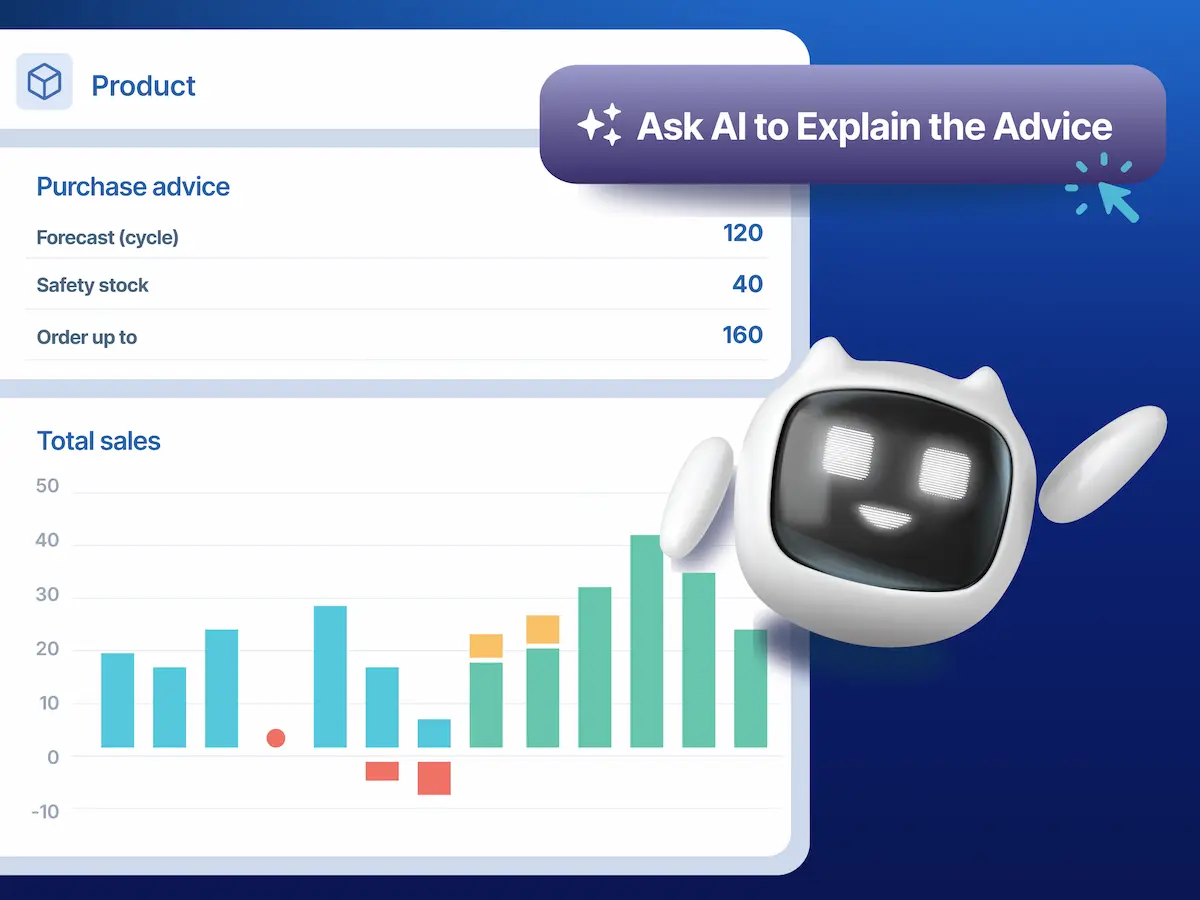
- Explains every recommendation in plain language at the SKU level, tracing back to stock position, demand forecast and safety stock
How it scores:
- Automation depth: doesn't stop at a recommendation. Customers report automation levels from 92% (Mastertools) up to 96% (Travelbags), with people stepping in only for exceptions.
- Supplier complexity: matches each SKU to the best supplier using tracked lead times rather than promised ones, and switches suppliers automatically when a stock check turns up a better option.
- ERP fit: connects directly to ERPs (Exact, NetSuite, Microsoft Dynamics 365, AFAS, Odoo and more) and e-commerce platforms (Shopify, WooCommerce, Magento, Lightspeed), plus warehouse systems. There's usually a direct connection rather than a workaround.
- Explainability: treated as a design requirement, not an afterthought. Every recommendation traces back to inventory position, demand forecast and safety stock, with escalation only when something falls outside agreed guardrails.
2. EazyStock
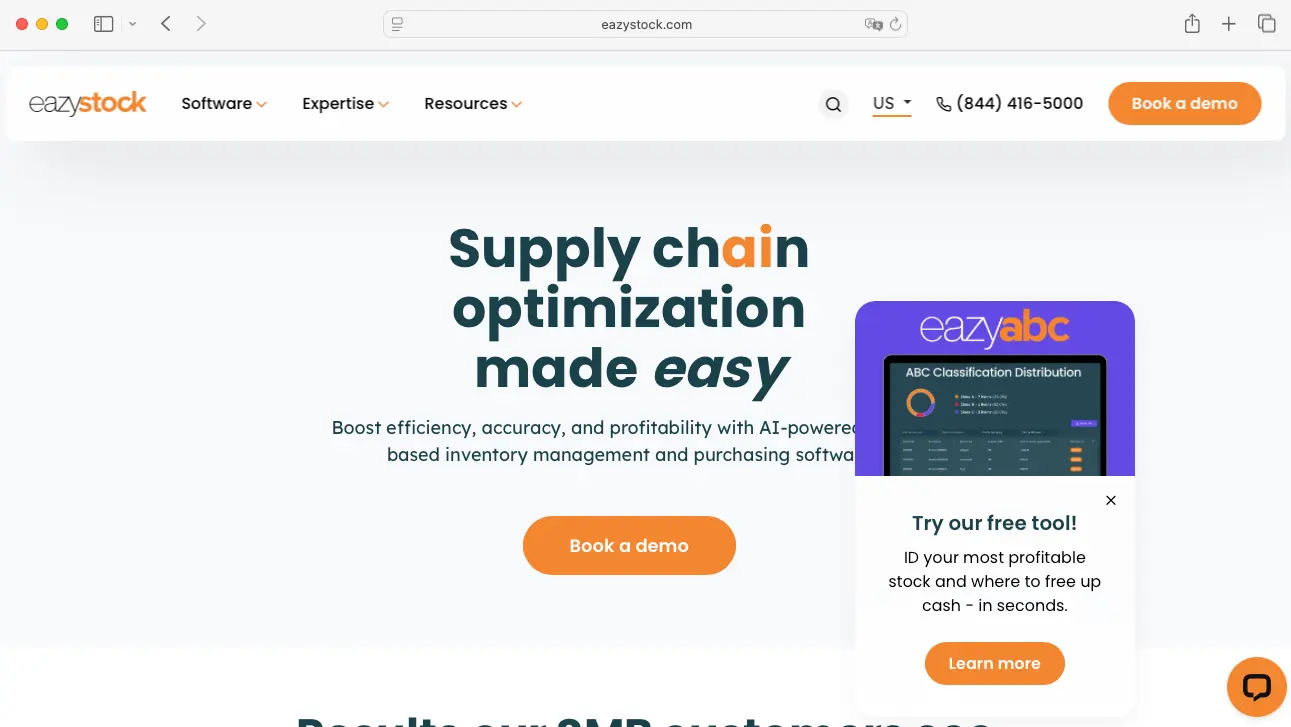
Best for mid-market teams running an established ERP that want inventory optimisation layered on top
EazyStock is an inventory optimisation tool designed to work alongside an existing ERP. It calculates reorder points, safety stock and order quantities, then generates a proposal for approval - a genuinely capable option for teams already running a supported ERP.
Key features:
- Calculates reorder points, safety stock and order quantities automatically
- Order fill-up feature specifically built to hit supplier minimums without overordering
- Integrations with Microsoft Dynamics, NetSuite, SAP, Acumatica and more
How it scores:
- Automation depth: recommends, doesn't place the order itself. Every proposal needs manual approval, though it lets a team focus review time on flagged exceptions rather than every line.
- Supplier complexity: handles MOQs and scheduled supplier orders well.
- ERP fit: runs deep where it connects, but is entirely dependent on already having a supported ERP in place. It lists only ERP connectors, with no native e-commerce or POS integration, so a business running Shopify or WooCommerce without an ERP underneath has no listed way in.
- Explainability: shows order proposals and risk-of-runout reports. Some users say the reasoning behind a specific number could go deeper.
3. Netstock
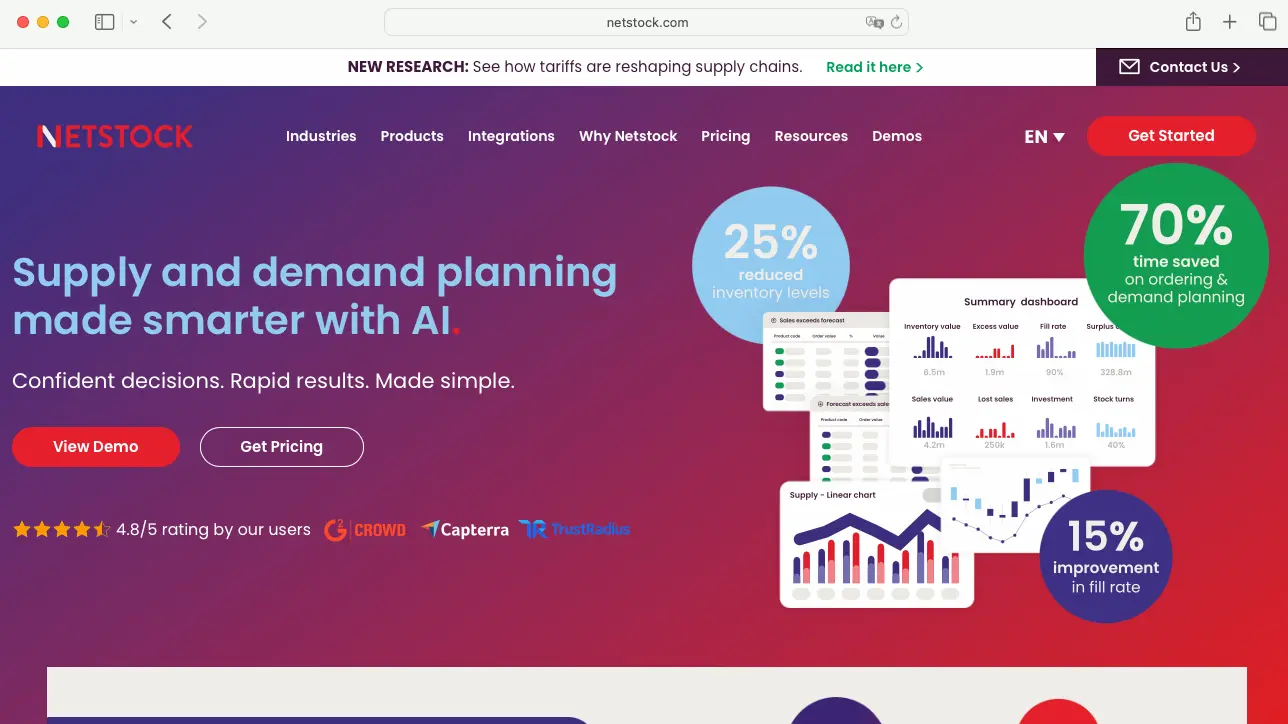
Best for teams that need the widest possible ERP coverage
Netstock is built around ERP breadth. Independent listings confirm coverage spanning Dynamics GP, SAP Business One, SAP S/4HANA, Sage, NetSuite, Acumatica and more.
Key features:
- Tracks supplier performance and lead times to generate PO suggestions that factor in fill rates
- Wide ERP connector coverage, including Dynamics GP, SAP Business One, SAP S/4HANA, Sage, NetSuite and Acumatica
- Dashboards for stockouts and excess stock
How it scores:
- Automation depth: recommend-and-review. Planners look at the items it flags rather than every single line, and it isn't designed to place orders on its own.
- Supplier complexity: tracks supplier performance and lead times well, though some users note its forecasting models can be rigid for volatile SKUs and need manual overrides.
- ERP fit: one of the wider ERP connector ranges among the ERP-tethered tools here, though breadth doesn't guarantee configuration depth on every connector.
- Explainability: strong dashboards, but customising the underlying "why" view is somewhat limited. A technical review by Lokad scored its technical transparency 3.8 out of 10, describing it more as a packaged planning application than a fully transparent decision engine.
4. Prediko
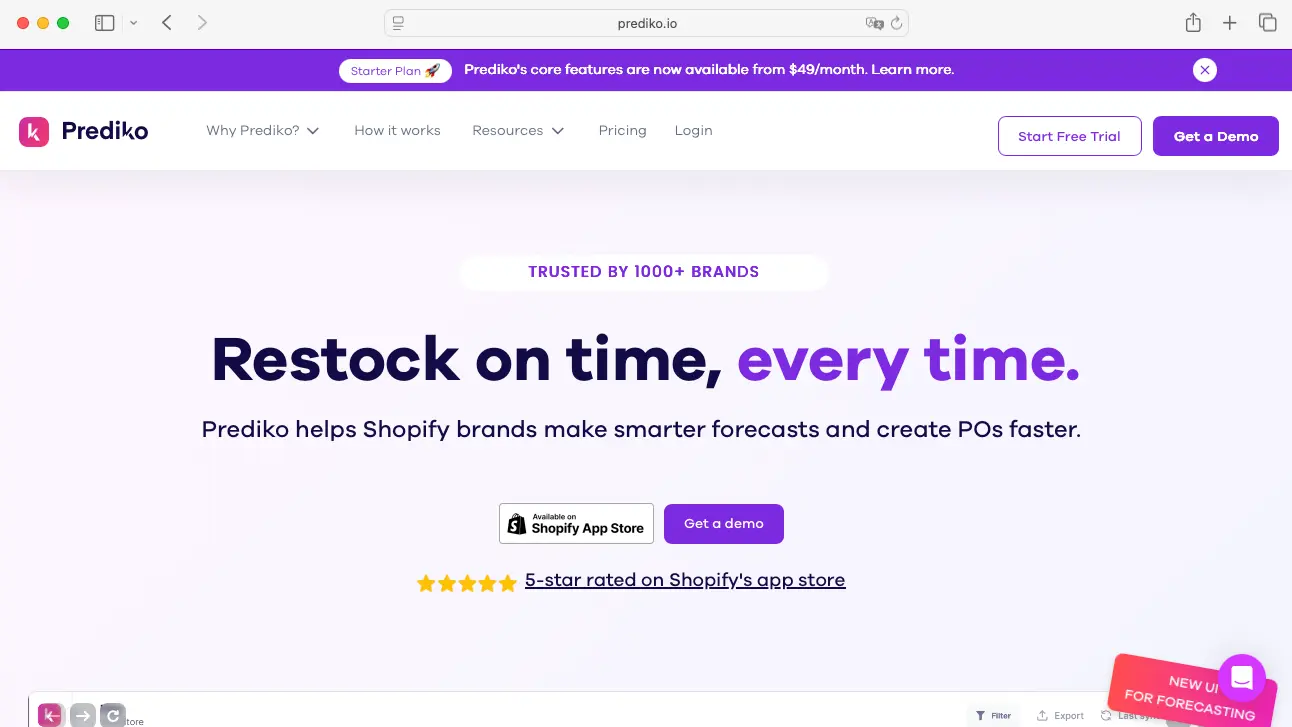
Best for direct-to-consumer brands selling on Shopify
Prediko is a Shopify-native tool built for direct-to-consumer brands. It emphasises speed and simplicity over deep supply-chain complexity, giving fast-growing Shopify merchants real-time inventory visibility aligned with campaigns and seasonal sales.
Key features:
- Drafts full purchase orders, not just suggestions
- Built-in PO financing, a feature none of the ERP-tethered tools on this list offer
- Native to Shopify, Shopify Plus and fulfilment apps like ShipBob, ShipHero and Amazon MCF
How it scores:
- Automation depth: drafts full purchase orders. A person still finalises and sends the order.
- Supplier complexity: functional but lighter-weight here - not built for complex multi-supplier constraint modelling.
- ERP fit: e-commerce-native rather than an ERP integration.
- Explainability: its Buying Table shows what, how much and when to order, without a detailed breakdown of the reasoning behind it.
5. RELEX Solutions
Best for large retailers and grocers running complex, multi-echelon supply chains
RELEX is an enterprise-grade platform for large retailers, grocers and supply chain-driven businesses, covering forecasting, replenishment, assortment, promotions and workforce planning end to end. For companies without highly complex operations, it may feel like more than they need compared with lighter, automation-first tools.
Key features:
- Can run touchless replenishment, placing orders automatically with a rules-based override built in
- Built for multi-echelon, multi-supplier networks, with automated truck and container-fill sequencing across supplier groups and locations
- Broad enterprise integration coverage
How it scores:
- Automation depth: can run touchless replenishment, but getting there takes real supply-chain methodology knowledge to configure well, reviewers note, not just general software literacy.
- Supplier complexity: built for multi-echelon, multi-supplier networks. A few reviewers mention historical gaps in specific logistics scenarios, like freight-limit projections.
- ERP fit: broad enterprise integration, but as a configurable suite a team adapts its processes to, not a plug-and-play rollout. Implementations tend to be sizeable, a poor fit for smaller or mid-sized operations.
- Explainability: configurable "why" views, but a technical review by Lokad scored its technical-transparency dimension 4.0 out of 10 (a sub-score - Lokad's overall RELEX rating is 4.9/10), noting it "discloses enough to prove the platform exists and scales, but not enough to make the quantitative core broadly inspectable."
AI purchasing software at a glance
Across the five tools, the real differences come down to how much each one automates versus recommends, how it handles multi-supplier complexity, how directly it connects to your ERP, and how much it explains its own decisions. Here's that comparison side by side.
Will AI purchasing software replace your purchasing team?
That's usually the wrong question, and we say that as the company selling the software. Buyers rarely ask whether this will replace them. What they actually want to know is how they can trust it's making the right call.
"Adoption doesn't stall because of the AI itself. It stalls because people can't see why a recommendation is what it is. We built the agent to open that black box: here's your stock position, here's the expected demand, here's the safety stock, and that's why you need to order this." - Sander, co-founder of Optiply
Our answer is full autonomy with full oversight. Every purchasing decision Optiply makes is explained in context: what changed, why the order was placed, what happens next.
Handle an exception once, and it becomes the new baseline rather than a recurring fire drill. What that actually buys your purchasing team is time: less of it spent re-keying orders and chasing suppliers, more of it spent on supplier negotiations, new product ranges, and the handful of exceptions that genuinely need a person's judgement.
How do you choose the right purchasing software for a multi-supplier business?
Once a business is juggling more than 15 suppliers, each with its own MOQ and order window, a plain recommendation stops being useful information and starts being another task on someone's desk. Whether you're a wholesale distributor managing that many suppliers directly or a multi-channel retailer managing dozens of SKU-supplier combinations, nobody has time to manually convert every suggestion into a purchase order once the count climbs that high.
That's the point where automation depth stops being a nice-to-have.
A few things worth checking before you commit to any tool on this list:
- Integration with the system you actually run. Ask for the exact ERP or e-commerce connector by name, and get a live reference customer running it in production on that same system.
- MOQ and order-window handling per supplier. A single global rule breaks down once your supplier base gets diverse. Confirm the tool applies a different rule automatically, per supplier, without you configuring exceptions by hand.
- Supplier-facing communication. Confirm whether the tool sends the order itself, over EDI, a portal or email, or whether your team still has to relay it.
- Decision explanations your buyers can act on. Ask to see it explain a real recommendation live in the demo, on your own data.
- A live customer reference in your segment. A named account at a similar SKU and supplier scale tells you far more than a logo on a website.
Whichever tool you land on, most vendors here, us included, will walk through your actual supplier list in a demo rather than a generic dataset. Use that conversation to test these criteria directly rather than taking any vendor's word for it.
If your purchasing process still needs tightening before software makes sense, our guide to optimising your purchasing process is a better place to start, and if your procurement KPIs are still informal, here's what to track first.
Where AI purchasing software makes the biggest difference for your business
Most AI purchasing software gets you a better recommendation. What we set out to build gets the order placed, the supplier notified and the decision explained, so your team spends its time on the exceptions that actually need a person.
In practice, that means the agent reads your live stock position and tracked lead times, matches the SKU to the right supplier, generates the purchase order and sends it, over EDI, a portal or email, then logs the reasoning behind it so anyone on the team can see why. The real cost difference between these tools isn't the licence fee, it's how much manual work still sits between the recommendation and the order actually going out. For a closer look at how an AI agent handles that end to end, see our guide to AI agents for procurement teams.
If that's the gap you're trying to close, book a demo and we'll map it against your actual suppliers, MOQs and order windows rather than a generic dataset.
FAQ about AI Purchasing Software
How much does AI purchasing software cost?

The strongest options connect both ways, not a one-off CSV export. Stock levels, purchase orders and supplier records sync automatically between the two systems, so a change made in either one shows up in the other the same day. Ask a vendor for the exact connector they support for your ERP, and ask to see it running on a live account before you commit.
Does AI purchasing software integrate with my existing ERP?
The strongest options connect both ways, not a one-off CSV export. Stock levels, purchase orders and supplier records sync automatically between the two systems, so a change made in either one shows up in the other the same day. Ask a vendor for the exact connector they support for your ERP, and ask to see it running on a live account before you commit.
How long does it take to implement AI purchasing software?
Implementation timelines vary with ERP complexity, supplier count and how clean your existing data is - most AI purchasing software takes anywhere from a few weeks to a full quarter to go live. For Optiply customers specifically, most are live within weeks, not months: the system connects to your ERP, learns your demand patterns and supplier setup, and starts generating optimised orders without a long IT project attached.
Is AI purchasing software worth it for a smaller wholesale business?
Once you're managing several hundred SKUs across multiple suppliers, the manual cost of purchasing, missed reorders, emergency freight and one person holding all the supplier knowledge tends to outweigh the cost of the software well before you reach enterprise scale.
Can I trust an AI agent to place purchase orders without reviewing them first?
That trust should build gradually rather than all at once. Look for a tool that explains every decision and lets you set the boundary yourself for what it handles autonomously versus what still comes to you as an exception.


.jpg)
.webp)