



In short
- Demand planning turns a forecast of future customer demand into concrete decisions on stock, staffing and supplier orders.
- It sits one level above demand forecasting. Forecasting predicts the number, demand planning decides what to do with it.
- Get it right and you avoid two costly outcomes at once, stockouts that lose sales, and excess stock that ties up cash.
- AI-driven tools now handle the heavy calculation, so planners spend their time on judgement calls instead of spreadsheets.
What is demand planning?
Demand planning is the process of predicting how much of each product customers will want, then translating that prediction into decisions: how much stock to hold, when to reorder, and how much to commit to each supplier.
For an online retailer, that means reading sales history, seasonality and supplier lead times, then deciding exactly how many units of each SKU to hold and when the next order needs to go out. Done well, it's invisible, products are simply there when customers want them; done badly, it shows up as stockouts on your best sellers or dead stock clogging your warehouse.
Demand planning is a recurring cycle, forecast, plan, execute, review, adjust, not a one-off exercise. Businesses that treat it as continuous, not a quarterly spreadsheet exercise, keep both service levels and stock costs under control at once.
What are the core components of demand planning?
A working demand planning process rests on three things: the people involved, the data feeding it, and the technology turning that data into decisions. Weakness in any one undermines the other two.
1. Collaboration across teams
Demand planning touches sales, purchasing, finance and operations, and each team sees a different piece of the picture. Sales knows about a promotion before it hits the sales history, while finance knows what cash is actually available for the next purchase order.
That gap is common, and it's expensive to ignore. In a McKinsey survey of 54 senior executives, only about one in four said their planning process balanced cross-functional trade-offs effectively.
Companies that get this right see the payoff directly. McKinsey found mature integrated planners running service levels 5 to 20 percentage points higher, with 40 to 50% fewer missed sales and delivery penalties.
Optiply's own Inventory Intelligence Index takes this further. AI can already take over 59% of a demand planner's work, freeing up time for exactly the judgement calls a spreadsheet can't make.
2. Data management
A demand plan is only as good as the data behind it. That means clean sales history, accurate stock levels across every warehouse and channel, and current supplier lead times.
Many businesses discover during a demand planning refresh that their biggest problem isn't the forecasting model, it's that stock levels in the system don't match the warehouse, or that lead times were entered once and never updated.
Sorting your catalogue with an ABC analysis first makes this easier, since it shows which SKUs deserve the tightest data discipline and which can tolerate a wider margin of error based on each product's importance to the business. A-products are your bestsellers and get the closest attention.
3. Technology
Spreadsheets can carry a demand plan for a business with a few hundred SKUs and one supplier. They stop working long before a business reaches the thousands of SKUs and multiple suppliers that most growing e-commerce and wholesale businesses manage.
At that scale, the calculation volume outgrows what one planner can recheck manually, which is where purpose-built demand planning and replenishment software, including AI-driven tools, takes over the calculation.
How do you build a demand planning process in three steps?
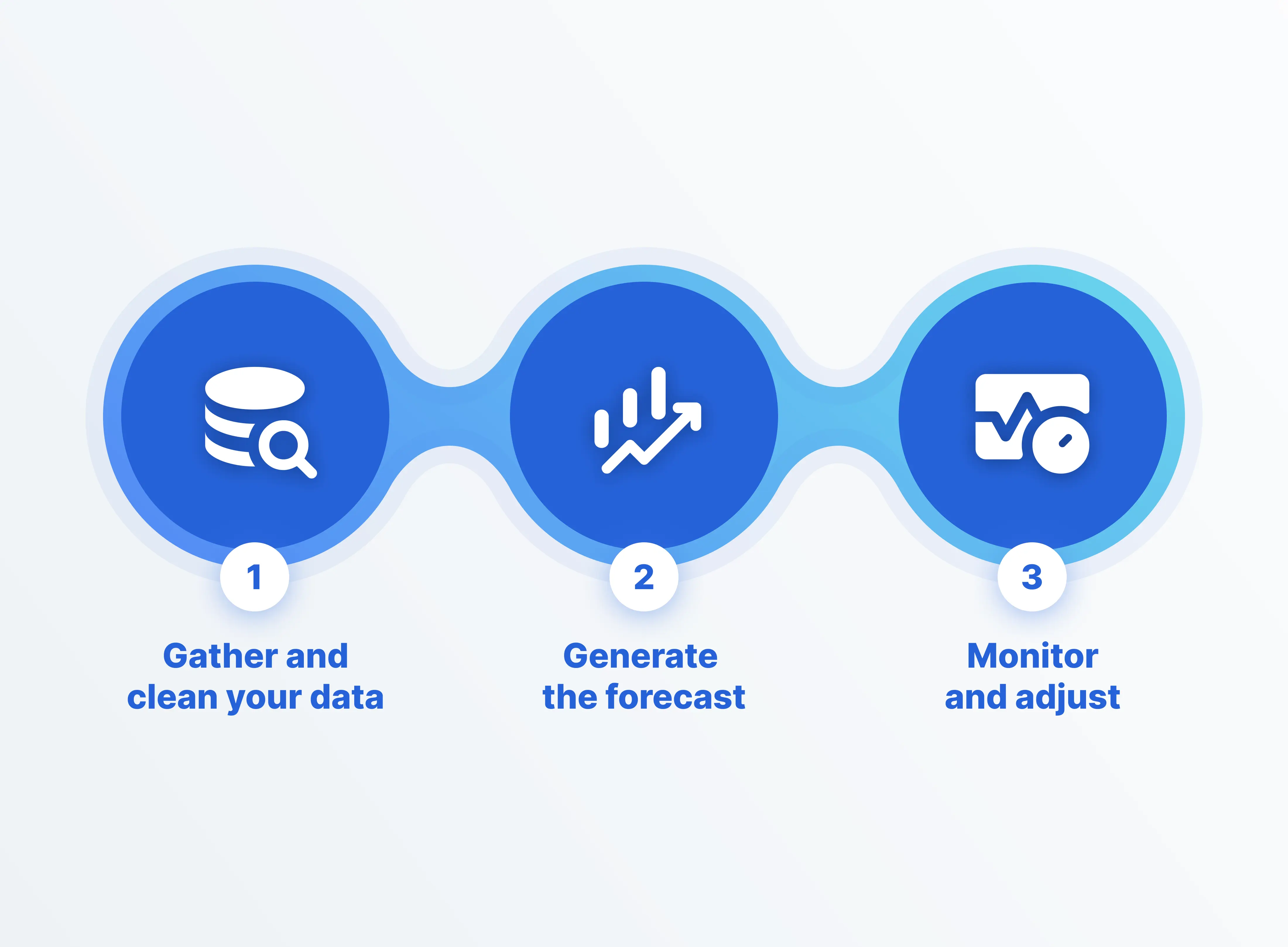
With people, data and technology in place, building the process itself comes down to three repeatable steps.
- Gather and clean your data: pull together sales history, current stock levels and supplier lead times from every channel and warehouse you operate. This step is unglamorous, and it's where most demand planning failures start.
- Generate the forecast and translate it into a plan: turn the historical data into a demand forecast per SKU, then convert that forecast into concrete numbers: reorder points, order quantities and timing per supplier.
- Monitor and adjust: no forecast survives contact with reality unchanged. Track actual sales against the plan, and adjust for promotions, seasonality shifts and supplier delays as they happen.
What common challenges do e-commerce businesses face with demand planning?
A few obstacles come up again and again, no matter how solid the underlying process is.
- Unreliable data: stock counts that don't match the warehouse, sales history with gaps from past system migrations, or supplier lead times that were never updated all quietly undermine a demand plan before it's even built.
- Market volatility: demand doesn't move in a straight line, and viral moments, competitor promotions or shifting consumer sentiment can throw a forecast built on historical patterns off course.
- Internal resistance: a new demand planning process usually asks people to change how they work, whether that's a purchaser who trusts their own gut over a system recommendation, or a sales team unused to sharing promotion plans.
If any of that sounds familiar, it's worth checking whether the problem is really the forecast, or the process around it. These are the signs your demand planning process needs fixing, and what to do about each one.
What are the best practices for demand planning?
A few habits separate teams that keep a demand plan reliable from teams that let it drift out of date.
- Review on a schedule, not just when something breaks: revisit the plan regularly and update it as new sales data or market shifts come in, rather than only after a stockout forces the issue.
- Make results visible: a shared dashboard gets purchasing, sales and finance looking at the same numbers, which is what turns demand planning into a team process instead of one person's spreadsheet.
- Let the model do the pattern-matching: machine learning and AI tools pick up on demand patterns that are hard to spot by eye, and get more accurate the longer they run against your own sales history.
How does AI improve demand planning accuracy?
AI improves demand planning by handling the calculation volume no human planner can realistically recheck by hand. Think of all the thousands of SKUs, each with their own seasonality, lead time and supplier constraints. AI recalculates continuously rather than once a month.
McKinsey research on AI-driven forecasting found that moving off manual methods can cut forecast error by 20-50%, and reduce lost sales from stockouts by up to 65%.
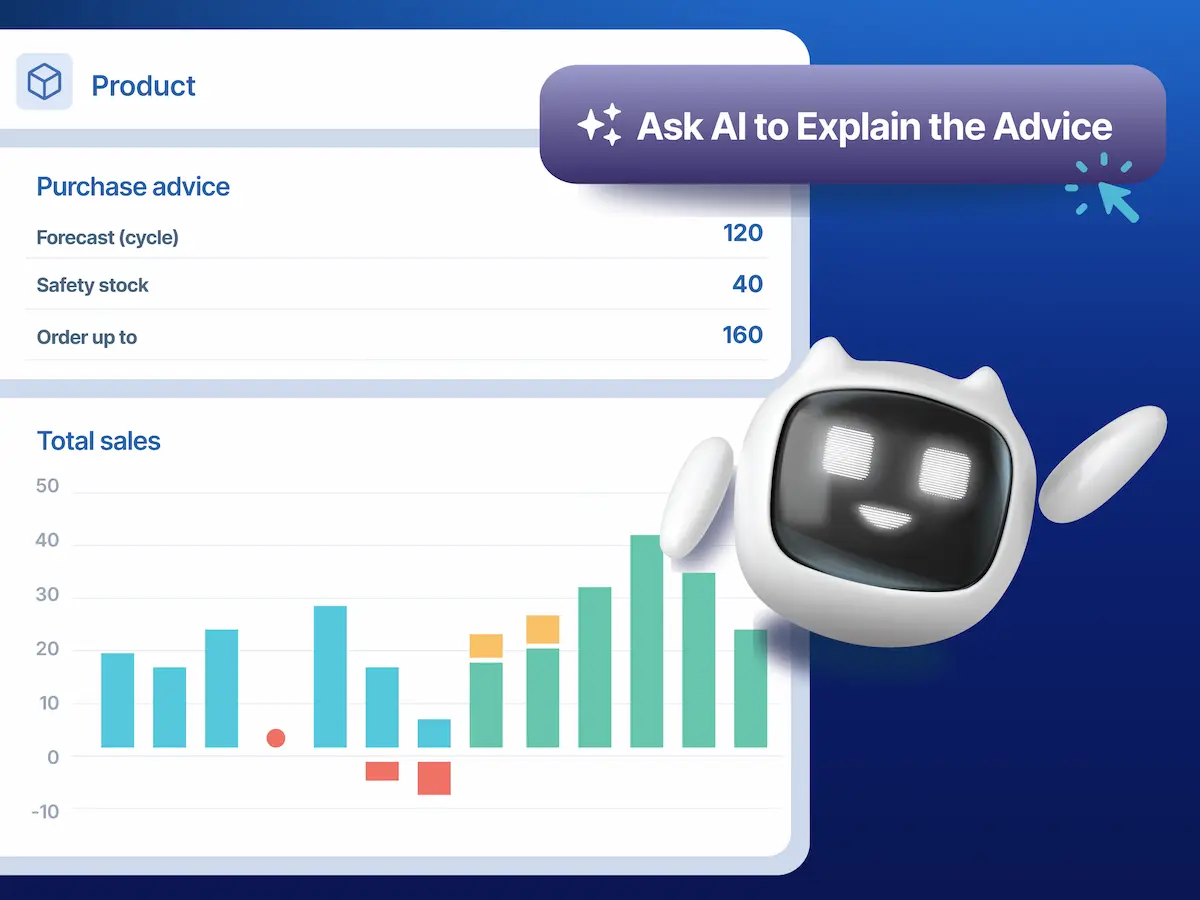
The other shift AI brings is explainability. A demand plan that just outputs a number, with no reasoning attached, is hard to trust and even harder to correct. The better AI-driven tools show why a recommendation was made and let a planner adjust it once, with that correction becoming the new baseline going forward.
Tackle Group Europe is a useful example of what this looks like in practice: after automating its replenishment decisions, the business grew revenue by 20% while needing 3% less stock to support that growth.
This is also where demand planning connects directly to day-to-day operations like preventing stockouts and automating replenishment. A demand plan is only useful if it actually reaches a purchase order on time.
Manual vs AI-driven demand planning at a glance
Demand planning KPIs: How do you measure whether you’re planning demand successfully?
Three KPIs give a fast, honest read on demand planning performance.
1. Forecast accuracy = 100% − (|Forecast − Actual demand| ÷ Actual demand × 100%)
Forecast accuracy shows how close your forecast was to what you actually sold, as a percentage. Most sectors call 90% or higher healthy.
2. Inventory turnover ratio = Cost of goods sold (COGS) ÷ average inventory value
The inventory turnover rate tracks how many times you sell through your entire inventory in a given period, usually a year. Two turns a year usually means excess stock sitting on the shelf. Six turns a year usually means you're managing stock efficiently.
3. Order fill rate = (fulfilled orders ÷ total orders) × 100%
This is the share of customer orders you can fulfil completely and on time from stock on hand. 95% or higher is considered strong. Anything meaningfully lower is lost revenue you can trace back to a stock problem.
Watching these three numbers on a dashboard, instead of recalculating them by hand each month, is what lets a team catch a slide in forecast accuracy before it turns into a stockout. A KPI that stays low for months usually points to a problem with the input data, not the model. You can think of gaps in sales history, or market signals the forecast never picked up.
Demand planning trends: what to expect for the near future?
For e-commerce, operating in a market that shifts by the week, four trends are shaping where demand planning goes from here.
Real-time data integration
Online stores already sit on multiple data streams: website traffic, social signals, weather, competitor pricing. API connections that feed this straight into a demand planning system let a business react to a flash sale or a sudden spike within the same day, instead of after the next weekly report, without overstocking to cover the uncertainty.
AI and machine learning
More and more demand planning software uses AI and machine learning to improve planning and forecasting. These models keep learning from new sales data, so accuracy compounds over time instead of resetting each planning cycle.
A model that spots a shift in buying behaviour or an early seasonal signal can turn that straight into a purchasing recommendation, cutting both the manual hours spent building forecasts and the errors that come with doing it by hand.
The next step beyond a recommendation is an agent that acts on it. Optiply's Supply Chain Agent, for example, goes further than flagging an exception or suggesting a purchase quantity. It places the order, tracks the supplier, and reconciles the invoice once it arrives, with a person approving anything sensitive along the way.
Flexible planning methodologies
Fixed planning cycles, monthly or quarterly, are becoming the exception rather than the rule. Tools built for continuous replanning turn an unexpected spike in one SKU into an updated reorder recommendation automatically, rather than waiting for the next scheduled review.
Sustainability
Buyers increasingly factor a retailer's environmental footprint into where they shop, and that's starting to shape demand planning too. Software that optimises which warehouse holds which stock can cut unnecessary transport moves, which lowers cost and emissions at the same time.
None of these are optional extras bolted onto an existing process: each one changes how fast a business can respond when demand moves, which is increasingly the difference between keeping a customer and losing one to a competitor who reacted first.
See what agentic demand planning looks like for your own data
Demand planning sits at the centre of a modern e-commerce supply chain, tightening inventory turnover, cutting excess stock, and lifting order fill rates all at once. Get the forecast right and the plan built around it follows: better cash flow, lower storage costs, and more room to move when the market shifts.
Technology does the heavy lifting here. Predictive analytics, ERP systems and AI-driven software, tools like Optiply among them, turn raw sales and stock data into a purchasing decision a team can act on the same day, not at the end of the month. That same visibility also makes cross-department collaboration easier: purchasing, sales and finance working from one shared number instead of three different spreadsheets.
Reading about agentic demand planning is one thing. Running your own SKUs, suppliers and lead times through it is another. Handing demand planning and replenishment to a supply chain agent is a real decision, so we help you connect your actual data and build a concrete business case, showing the forecast, the automation rate, and the inventory impact for your assortment specifically.
Book a 15-minute demo to see the business case on your own data.
FAQ about demand planning
Is demand planning the same as inventory management?

In practice it's usually shared: purchasing or supply chain owns the process, but sales and finance both feed it and are affected by it. Businesses that treat it as one person's spreadsheet are usually the ones with the biggest data gaps.
Who is responsible for demand planning in a business?
In practice it's usually shared: purchasing or supply chain owns the process, but sales and finance both feed it and are affected by it. Businesses that treat it as one person's spreadsheet are usually the ones with the biggest data gaps.
How much does demand planning software cost?
Pricing typically scales with SKU count and supplier complexity rather than a flat fee, since the calculation load grows with both. Most vendors will size a quote against your actual catalogue rather than a published price list.
Is demand planning only for large companies, or does it work for smaller e-commerce businesses too?
No, demand planning scales down just as well as it scales up. A smaller e-commerce business can run it on a spreadsheet for a few hundred SKUs and one supplier without much trouble; the workload and error rate only start outpacing manual tracking once SKU count and supplier complexity grow past that point.
How long does it take to see results after improving a demand planning process?
Most businesses see a measurable shift in stockouts and excess stock within one to two full sales cycles, since that's how long it takes the new process to run through a complete seasonal pattern.


.jpg)
.webp)