Welcome
Welcome, everyone, and thanks so much for making time, during the extremely busy Black Friday period, to listen to our story. We'll start at 13:00 sharp.
I'll be speaking Dutch. The webinar will also go on YouTube afterwards, with subtitles, so you can always watch it back in English.
The webinar series Ask My Agent Anything (AMAA)
Welcome to the first part of AMAA, Ask My Agent Anything. We'll do this three times, every two weeks. Half an hour in which I briefly tell you about our agent and how you can use it, because it's changing how purchasing works and how you can best use a platform like Optiply.
AI isn't just the topic of the moment in purchasing, but in every part of the economy, software companies included. We're doing everything we can to stay ahead and want to take everyone along.
Today is about supplier offers. That's very timely, because towards the end of the year you either hit your targets or you don't. Suppliers want to hit their own targets and make you one more offer that you may or may not want to take. We'll go all in on that today.
About Optiply, and why AI is so close to home
First, a little about me. I'm Sander, one of the two founders of Optiply. We've been building Optiply for more than ten years now, with a team of over 40 people spread across three offices. And AI is so close to home for us because development has accelerated enormously lately.
We jumped on the AI bandwagon about two years ago, because we saw early on that it has enormous potential. Over the past months we've sped up all our internal processes with AI, from customer success and sales to development. Around 60% of our code now comes from AI, compared with 10 to 15% at the start of the year. And our engineers ship twice as many successful changes as at the beginning of October. That's the acceleration of the past six, seven weeks. We're now speeding this up together with customers inside the platform too.
The Optiply Agent has been live since April. You can use it from Claude, from OpenAI and from Slack. We see usage growing week over week, and it's now our most used feature. I'm someone who has done a lot of things, made a lot of mistakes and wasted a lot of tokens. We're now trying to bring those learnings to our customers too, so you don't have to make those mistakes.
What Optiply does: the five pillars
A quick word for those who don't work with Optiply yet: Optiply is the platform that lets your purchasing run fully autonomously. You automate everything and keep making optimal decisions, so you can grow much more with far less cash tied up in stock, with a scalable process because it runs completely automatically. That's where we stand out in the market: we really aim at the automation part.
We do that with five pillars. Planning: when do I need to order? Forecasting: how much do we expect to sell, and so what do we need to buy? That's one of the things AI is speeding up enormously. We simply keep getting better at forecasting.
Replenishment: I know what I'm going to sell and I know when I need to buy. How much should I order to hit exactly the right balance? That's an enormously complex problem we've been working on for ten years, and we still ship improvements every month.
External data: we take more and more data from your whole supply chain into account, such as suppliers' stock, so you never over-buy, and so that switching between suppliers can happen optimally and automatically.
Purchase to pay: after your order, the EDI message goes out automatically, or the order is created in a portal, so you no longer have to do it by hand.
All of that to fully automate purchasing. And because we have all five pillars, we can really push purchasing towards full automation. We do that on a solid foundation we've been building for ten years. The data from your POS, ERP and WMS is by now fully processed and securely stored. The latest layer on top is the agent: the agentic layer that brings all of this together and speeds it up enormously.
Agenda and the Optiply Agent in five minutes
Today's agenda: first, Optiply and the agent in five minutes. Then a number of examples of what those discounts look like. And then we go live: we took questions from customers and fed them to the agent. If you have questions, we can run them here live.
The question we get most about the agent is: which offer from my supplier should I take, and which not? That's a good example. Optiply is, at its core, replenishment: the repeating standard work, and we've fully automated that. This was a case that comes up fairly regularly but is different every time. It didn't fit well in our standard software, but an agent can solve it extremely well.
To keep it interactive: put your questions in the chat, and I'll pick them up at the end.
The Optiply Agent: our fastest-growing feature
As I said, the agent is our fastest-growing feature ever. We launched in April, and after the summer usage really took off. That goes against our normal features, because most features see less use towards Black Friday, but this one keeps growing. That bodes well for the rest of the year and for next year.
A lot of work is going into it, too. Last week, around 200 changes and updates were made to the agent, and over 1,000 last month. Small things and big things, all to make it better. Every night we check all the questions where things didn't go well, and everything that can be faster. We're constantly at it, and security gets an enormous amount of work as well. I expect this pace not to slow down in the coming period.
Three typical supplier offers
A practical example. You often see a supplier suddenly calling: "We have a really nice, sharp offer. I thought of you when I saw this, so I'm calling you first. I have this proposal for you." That will sound familiar to many buyers.
Or you agree targets: if we spend a million this year, we get a 4% kickback at the end of the year. Then it makes sense to hit your bonus. We see that people are either far too cautious or far too aggressive about it, and happily throw away a hundred thousand in holding costs to save 40,000 euros.
The third case we often see is sign-up lists. They're often tied to the supplier's production planning. The supplier says: if you sign up for that production run, you get a longer lead time but a much better price, and I can scale up production without taking the risk. On paper it always sounds very good. But it's a delicate balance with your stock, your cash flow and the question of when you'll order next.
Because you get a discount once, but the stock stays. With almost every company that starts with us, we see dead stock in the warehouse. "This was a really great deal, I bought four pallets of it. It was going to be a top seller anyway, the supplier said." But in the end, a deal a supplier offers is often mostly good for the supplier, and less so for the customer.
Why a simple rule of thumb doesn't work, and how the agent works out a discount
The problem with discounts is that a simple rule of thumb often doesn't work. The logical idea is: I divide my discount percentage by my holding costs. Say a product gets 15% off. If you typically calculate with 20% holding costs per year, that's interest, space and risk (rente, ruimte and risico in Dutch, the three R's of the supply chain), then you divide one by the other and I end up taking nine months of extra stock.
The tricky part is that this doesn't hold for products you don't sell often. Then you have no idea what nine months means. And that 20% might be as much as 200% for a product you almost never sell, because there's a big chance you'll never get rid of it. Then it becomes a very difficult calculation that you can barely work out.
On top of all the data and knowledge from our own years of experience, our agent has also learned the literature. Purchasing seems fairly simple, but when you really dive in, it gets very complex. I think there are more than 20 different methods for calculating which discounts to take or not, and which one fits best depends on the situation. The agent has all those methods in its brain. And it has all the data from Optiply: what's my forecast, what's my stock position, meaning what's already on its way, costs, price tiers, upcoming orders, risks. It knows all of it and combines it into one piece of advice.
It's also really being used: more than 41 questions on this topic per week. We did this based on data too, as we try to do everything: we looked at which topics users pick up a lot, and built around those. The price tiers, the price lists. We really see this growing enormously.
The agent has access to all that data, completely secure: it can only reach your own data. All the knowledge and experience we have, we've taught it, and we're still teaching it more. The agent can calculate, it can write code and simply work things out properly.
In the end you decide yourself, because the agent won't do it for you. It sets everything up. It can basically press every button you can press in Optiply, with your approval of course. I often set up a draft order, or I place the order in one go.
Demo 1: a year-end offer with minimum quantities
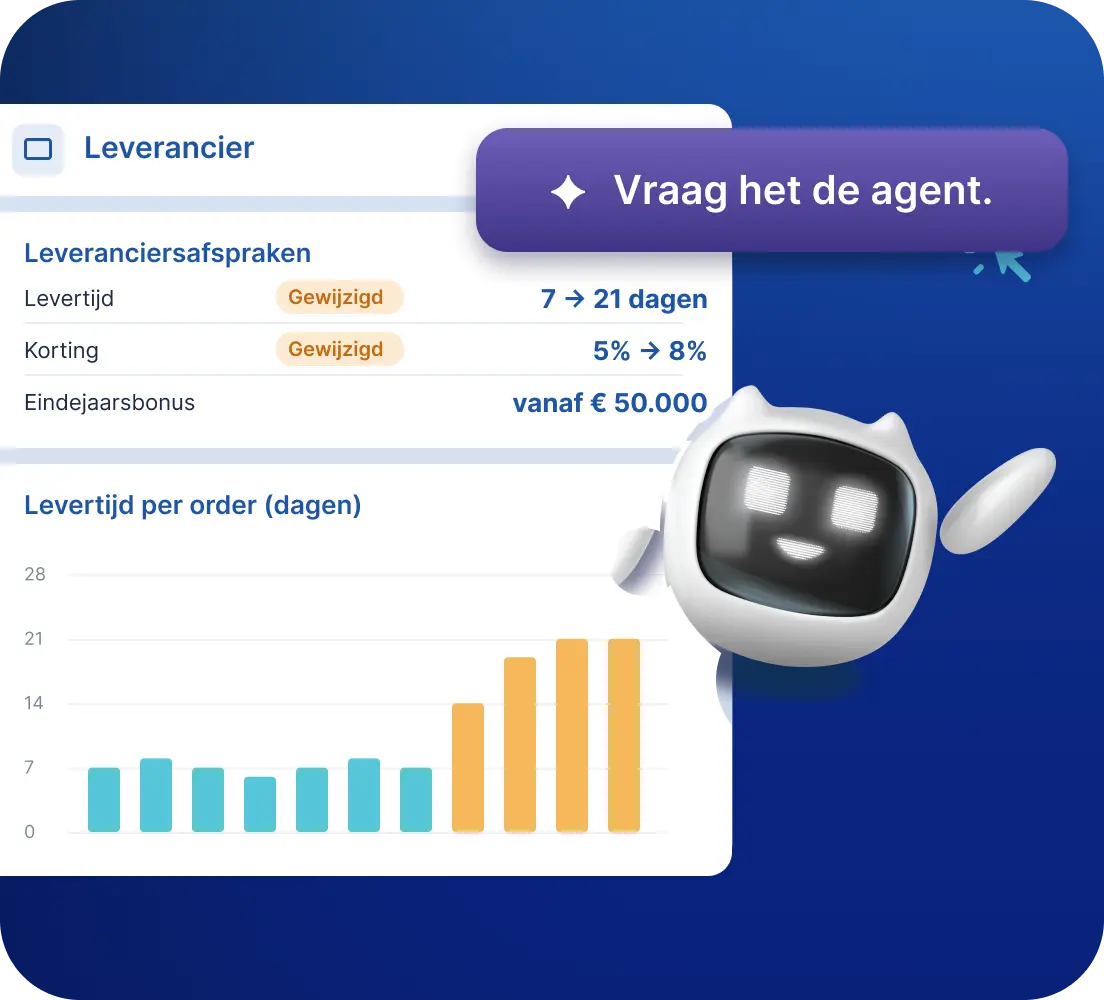
I picked two typical questions. The first: I have a year-end offer from my supplier, is it interesting? I made an example, based on our demo data. It's a very common situation: you get a PDF from the supplier. "If you order before Friday 27 November, you get these discounts at these minimum quantities. And if you order €10,000, you get another 2% off the whole invoice." A very common question.
You can upload that PDF into your agent, or into Claude if you've connected it via MCP. You can even set up a routine so that all emails with discounts are automatically passed to the Optiply agent.
Then it starts calculating. This takes a minute or two, which is why I prepared it. It neatly gives you, per item, the net benefit we could get, and what to do and what not to do. It looks at your stock cover over the minimum quantity and at what holding the extra stock costs, and weighs those against each other.
Then it says: leave these three products, because you'd put way too much down or sell far too little of them. There's a big chance you'd overshoot. It also checks whether that €10,000 is worth it. No, because then we'd actually have to spend €6,000 extra, and that would all be overstock. That doesn't work out for that 2%. You're better off keeping the money in your pocket and investing it elsewhere.
It gives you options too: you can click "create the draft orders", and then the order is ready to send. You don't have to do anything else.
Demo 2: tiered pricing and more examples
The second question: I have a supplier who offers price tiers on these products, with different prices per tier. The question then is: what's the smart move, how much of which product do I want to put down? This is an easy example, because 50% is fairly extreme. You get advice in one go, and then you can say: set this up and put that promotion in.
We see this a lot. An example from a user in the fitness industry: certain discounts, how much stock is there, how much should you not buy, and that's pushed through right away. Or a discount on bikes: that's long, expensive stock, so forget it.
Another very common one: "we still have to spend 100k this year to get our bonus." Here the agent said you don't have to do anything, because you'll get there with business as usual. And if it is needed, you're better off doing it at the end of December, so you do it as late as possible.
And another we've seen: "I get a one-off 15% extra discount, how much should I do?" Then it works it out neatly. It looks at last year's revenue, calculates it all the way through, and takes the discount.
Questions from the chat
A participant asks: can we take warehouse capacity into account as well as the cash effect?
Yes. If you fill in the dimensions of your products, we can calculate the volumes. Or if your capacity is in number of units, you can simply ask what the totals are right now. And if you can specify constraints, for example how many locations you have left, it will quite likely work that out too.
Good question, because it's also why that 20% for space, interest and risk is only a kind of approximation. If you have too much space, extra space is almost free. If you have too little, it becomes prohibitively expensive right away. That's the game you play continuously. The same goes for liquidity.
A participant asks: I have four stores in Optiply. How does that work if you have one shared target?
Good question. If you have one target across all stores, I'm thinking about whether the agent can work across four datasets at once. I'll get back to you on that: I need to check how it works security-wise and whether you're allowed to do that.
A participant asks: can we get a link to this webinar?
Yes. It's going on YouTube, so you can watch it back.
Closing
Right on time. Thank you very much, everyone, for your time. You can always reach out to me directly if you have any questions.